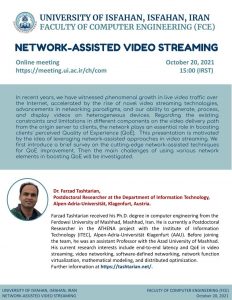
Farzad Tashtarian to give a talk at the University of Isfahan, Isfahan, Iran

Farzad Tashtarian is invited to talk on “Network-Assisted Video Streaming” at the University of Isfahan, Isfahan, Iran.

Posted in ATHENA | Comments Off on Farzad Tashtarian to give a talk at the University of Isfahan, Isfahan, Iran

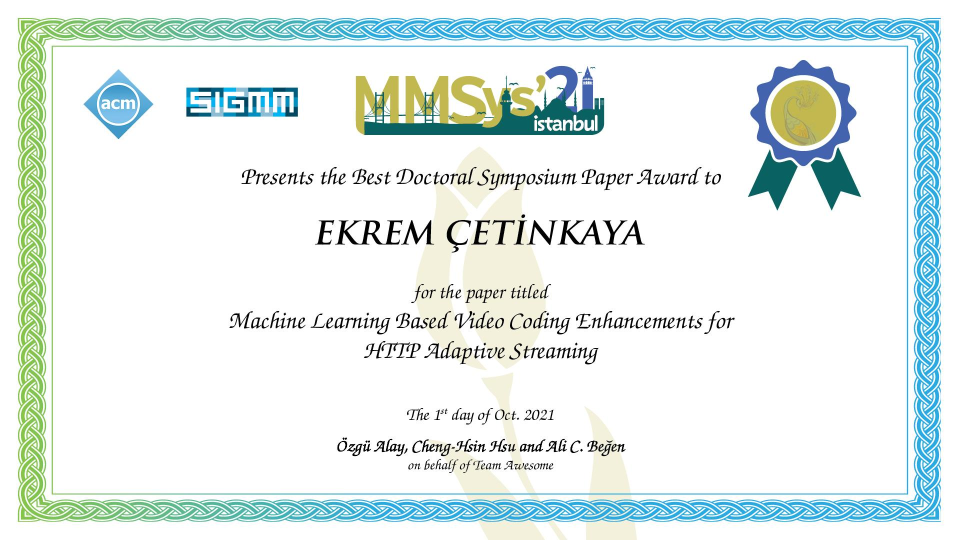
Best Doctoral Symposium Paper Award at ACM MMSys 2021

Ekrem Çetinkaya got the Best Doctoral Symposium Paper Award at ACM MMSys 2021 for his paper titled “Machine Learning Based Video Coding Enhancements for HTTP Adaptive Streaming”.

More information about the paper can be found in the blog post.

Posted in ATHENA | Comments Off on Best Doctoral Symposium Paper Award at ACM MMSys 2021

FAUST: Fast Per-Scene Encoding Using Entropy-Based Scene Detection and Machine Learning

FAUST: Fast Per-Scene Encoding Using Entropy-Based Scene Detection and Machine Learning

30th IEEE Conference of the Open Innovations Association FRUCT
27-29 October 2021
https://www.fruct.org/

[PDF][Slides][Video]

Anatoliy Zabrovskiy, Prateek Agrawal, Christian Timmerer, and Radu Prodan

Abstract: HTTP adaptive video streaming is a widespread and sought-after technology on the Internet that allows clients to dynamically switch between different stream qualities presented in the bitrate ladder to optimize overall received video quality. Currently, there exist several approaches of different complexity for building such a ladder. The simplest method is to use a static bitrate ladder, and the more complex one is to compute a per-title encoding ladder. The main drawback of these approaches is that they do not provide bitrate ladders for scenes with different visual complexity within the video. Moreover, most modern methods require additional computationally-intensive test encodings of the entire video to construct the convex hull, used to calculate the bitrate ladder. This paper proposes a new fast per-scene encoding approach called FAUST based on 1) quick entropy-based scene detection and 2) prediction of optimized bitrate ladder for each scene using an artificial neural network. The results show that our model reduces the mean absolute error to 0.15, the mean square error to 0.08, and the bitrate to 13.5% while increasing the difference in video multimethod assessment fusion to 5.6 points.

https://www.slideshare.net/christian.timmerer/faust-fast-perscene-encoding-using-entropybased-scene-detection-and-machine-learning

Posted in APOLLO, ATHENA | Comments Off on FAUST: Fast Per-Scene Encoding Using Entropy-Based Scene Detection and Machine Learning

FaRes-ML paper is Nominated for the Best New Streaming Innovation Award in the Streaming Media Readers’ Choice Awards 2021

The Fast Multi-Resolution and Multi-Rate Encoding for HTTP Adaptive Streaming Using Machine Learning paper from ATHENA lab is nominated for the Best New Streaming Innovation Award in the Streaming Media Readers’ Choice Awards 2021.

Voting can be done on the awards’ website. The voting is open until October 4. You can find the paper under the Best New Streaming Innovation Award section as following:

More information about the paper can be found here.

Posted in ATHENA | Comments Off on FaRes-ML paper is Nominated for the Best New Streaming Innovation Award in the Streaming Media Readers’ Choice Awards 2021

Improving Per-title Encoding for HTTP Adaptive Streaming by Utilizing Video Super-resolution

Visual Communications and Image Processing (VCIP 2021)

5-8 December 2021, Munich, Germany

[PDF][Slides]

Hadi Amirpour (Alpen-Adria-Universität Klagenfurt), Hannaneh Barahouei Pasandi (Virginia Commonwealth University), Mohammad Ghanbari (School of Computer Science and Electronic Engineering, University of Essex, Colchester, UK), and Christian Timmerer (Alpen-Adria-Universität Klagenfurt)

Abstract:

In per-title encoding, to optimize a bitrate ladder over spatial resolution, each video segment is downscaled to a set of spatial resolutions and they are all encoded at a given set of bitrates. To find the highest quality resolution for each bitrate, the low-resolution encoded videos are upscaled to the original resolution, and a convex hull is formed based on the scaled qualities. Deep learning-based video super-resolution (VSR) approaches show a significant gain over traditional approaches and they are becoming more and more efficient over time.  This paper improves the per-title encoding over the upscaling methods by using deep neural network-based VSR algorithms as they show a significant gain over traditional approaches. Utilizing a VSR algorithm by improving the quality of low-resolution encodings can improve the convex hull. As a result, it will lead to an improved bitrate ladder. To avoid bandwidth wastage at perceptually lossless bitrates a maximum threshold for the quality is set and encodings beyond it are eliminated from the bitrate ladder. Similarly, a minimum threshold is set to avoid low-quality video delivery. The encodings between the maximum and minimum thresholds are selected based on one Just Noticeable Difference. Our experimental results show that the proposed per-title encoding results in a 24% bitrate reduction and 53% storage reduction compared to the state-of-the-art method.

Index Terms—HAS, per-title, deep learning, compression, bitrate ladder.

https://www.slideshare.net/christian.timmerer/improving-pertitle-encoding-for-http-adaptive-streaming-by-utilizing-video-superresolution

Posted in ATHENA | Comments Off on Improving Per-title Encoding for HTTP Adaptive Streaming by Utilizing Video Super-resolution

On the Impact of Viewing Distance on Perceived Video Quality

IEEE Visual Communications and Image Processing (VCIP 2021)

5-8 December 2021, Munich, Germany

[PDF][Slides]

Hadi Amirpour (Alpen-Adria-Universität Klagenfurt), Raimund Schatz (AIT Austrian Institute of Technology, Austria), Mohammad Ghanbari (School of Computer Science and Electronic Engineering, University of Essex, Colchester, UK), and Christian Timmerer (Alpen-Adria-Universität Klagenfurt)

Abstract:

Due to the growing importance of optimizing quality and efficiency of video streaming delivery, accurate assessment of user perceived video quality becomes increasingly relevant. However, due to the wide range of viewing distances encountered in real-world viewing settings, actually perceived video quality can vary significantly in everyday viewing situations. In this paper, we investigate and quantify the influence of viewing distance on perceived video quality.  A subjective experiment was conducted with full HD sequences at three different stationary viewing distances, with each video sequence being encoded at three different quality levels. Our study results confirm that the viewing distance has a significant influence on the quality assessment. In particular, they show that an increased viewing distance generally leads to an increased perceived video quality, especially at low media encoding quality levels. In this context, we also provide an estimation of potential bitrate savings that knowledge of actual viewing distance would enable in practice.
Since current objective video quality metrics do not systematically take into account viewing distance, we also analyze and quantify the influence of viewing distance on the correlation between objective and subjective metrics. Our results confirm the need for distance-aware objective metrics when accurate prediction of perceived video quality in real-world environments is required.

Index Terms—video streaming, QoE, viewing distance, subjective testing.

https://www.slideshare.net/christian.timmerer/on-the-impact-of-viewing-distance-on-perceived-video-quality

Posted in ATHENA | Comments Off on On the Impact of Viewing Distance on Perceived Video Quality

INTENSE: In-depth Studies on Stall Events and Quality Switches and Their Impact on the Quality of Experience in HTTP Adaptive Streaming

IEEE Access, A Multidisciplinary, Open-access Journal of the IEEE

[PDF]

Babak Taraghi (AAU, Austria), Minh Nguyen (AAU, Austria), Hadi Amirpour (AAU, Austria), Christian Timmerer (AAU, Austria)

Abstract: With the recent growth of multimedia traffic over the Internet and emerging multimedia streaming service providers, improving Quality of Experience (QoE) for HTTP Adaptive Streaming (HAS) becomes more important. Alongside other factors, such as the media quality, HAS relies on the performance of the media player’s Adaptive Bitrate (ABR) algorithm to optimize QoE in multimedia streaming sessions. QoE in HAS suffers from weak or unstable internet connections and suboptimal ABR decisions. As a result of imperfect adaptiveness to the characteristics and conditions of the internet connection, stall events and quality level switches could occur and with different durations that negatively affect the QoE. In this paper, we address various identified open issues related to the QoE for HAS, notably (i) the minimum noticeable duration for stall events in HAS;(ii) the correlation between the media quality and the impact of stall events on QoE; (iii) the end-user preference regarding multiple shorter stall events versus a single longer stall event; and (iv) the end-user preference of media quality switches over stall events. Therefore, we have studied these open issues from both objective and subjective evaluation perspectives and presented the correlation between the two types of evaluations. The findings documented in this paper can be used as a baseline for improving ABR algorithms and policies in HAS.

Keywords: Crowdsourcing; HTTP Adaptive Streaming; Quality of Experience; Quality Switches; Stall Events; Subjective Evaluation; Objective Evaluation.

Posted in ATHENA | Comments Off on INTENSE: In-depth Studies on Stall Events and Quality Switches and Their Impact on the Quality of Experience in HTTP Adaptive Streaming