PCS’21 Special Session: Video encoding for large scale HAS deployments

Picture Coding Symposium (PCS)

29 June to 2 July 2021, Bristol, UK

Session organizers: Christian Timmerer (Alpen-Adria-Universität Klagenfurt, Austria), Mohammad Ghanbari (University of Essex, UK), and Alex Giladi (Comcast, USA).

Abstract: Video accounts for the vast majority of today’s internet traffic and video coding is vital for efficient distribution towards the end-user. Software- or/and cloud-based video coding is becoming more and more attractive, specifically with the plethora of video codecs available right now (e.g., AVC, HEVC, VVC, VP9, AV1, etc.) which is also supported by the latest Bitmovin Video Developer Report 2020. Thus, improvements in video coding enabling efficient adaptive video streaming is a requirement for current and future video services. HTTP Adaptive Streaming (HAS) is now mainstream due to its simplicity, reliability, and standard support (e.g., MPEG-DASH). For HAS, the video is usually encoded in multiple versions (i.e., representations) of different resolutions, bitrates, codecs, etc. and each representation is divided into chunks (i.e., segments) of equal length (e.g., 2-10 sec) to enable dynamic, adaptive switching during streaming based on the user’s context conditions (e.g., network conditions, device characteristics, user preferences). In this context, most scientific papers in the literature target various improvements which are evaluated based on open, standard test sequences. We argue that optimizing video encoding for large scale HAS deployments is the next step in order to improve the Quality of Experience (QoE), while optimizing costs.

Posted in ATHENA | Comments Off on PCS’21 Special Session: Video encoding for large scale HAS deployments

IEEE Communication Magazine: From Capturing to Rendering: Volumetric Media Delivery With Six Degrees of Freedom

From Capturing to Rendering: Volumetric Media Delivery With Six Degrees of Freedom

Teaser: “Help me, Obi-Wan Kenobi. You’re my only hope,” said the hologram of Princess Leia in Star Wars: Episode IV – A New Hope (1977). This was the first time in cinematic history that the concept of holographic-type communication was illustrated. Almost five decades later, technological advancements are quickly moving this type of communication from science fiction to reality.

IEEE Communication Magazine

[PDF]

Jeroen van der Hooft (Ghent University), Maria Torres Vega (Ghent University), Tim Wauters (Ghent University), Christian Timmerer (Alpen-Adria-Universität Klagenfurt), Ali C. Begen (Ozyegin University, Networked Media), Filip De Turck (Ghent University), and Raimund Schatz (AIT Austrian Institute of Technology)

Abstract: Technological improvements are rapidly advancing holographic-type content distribution. Significant research efforts have been made to meet the low-latency and high-bandwidth requirements set forward by interactive applications such as remote surgery and virtual reality. Recent research made six degrees of freedom (6DoF) for immersive media possible, where users may both move their heads and change their position within a scene. In this article, we present the status and challenges of 6DoF applications based on volumetric media, focusing on the key aspects required to deliver such services. Furthermore, we present results from a subjective study to highlight relevant directions for future research.

Posted in ATHENA | Comments Off on IEEE Communication Magazine: From Capturing to Rendering: Volumetric Media Delivery With Six Degrees of Freedom

MTAP paper: Automated Bank Cheque Verification Using Image Processing and Deep Learning Methods

MTAP paper: Automated Bank Cheque Verification Using Image Processing and Deep Learning Methods

Multimedia tools and applications (Springer Journal)

[PDF]

Prateek Agrawal (University of Klagenfurt, Austria), Deepak Chaudhary (Lovely Professional University, India), Vishu Madaan (Lovely professional University, India), Anatoliy Zabrovskiy (University of Klagenfurt, Austria), Radu Prodan (University of Klagenfurt, Austria), Dragi Kimovski (University of Klagenfurt, Austria), Christian Timmerer (University of Klagenfurt, Austria)

Abstract: Automated bank cheque verification using image processing is an attempt to complement the present cheque truncation system, as well as to provide an alternate methodology for the processing of bank cheques with minimal human intervention. When it comes to the clearance of the bank cheques and monetary transactions, this should not only be reliable and robust but also save time which is one of the major factor for the countries having large population. In order to perform the task of cheque verification, we developed a tool which acquires the cheque leaflet key components, essential for the task of cheque clearance using image processing and deep learning methods. These components include the bank branch code, cheque number, legal as well as courtesy amount, account number, and signature patterns. our innovation aims at benefiting the banking system by re-innovating the other competent cheque-based monetary transaction system which requires automated system intervention. For this research, we used institute of development and research in banking technology (IDRBT) cheque dataset and deep learning based convolutional neural networks (CNN) which gave us an accuracy of 99.14% for handwritten numeric character recognition. It resulted in improved accuracy and precise assessment of the handwritten components of bank cheque. For machine printed script, we used MATLAB in-built OCR method and the accuracy achieved is satisfactory (97.7%) also for verification of Signature we have used Scale Invariant Feature Transform (SIFT) for extraction of features and Support Vector Machine (SVM) as classifier, the accuracy achieved for signature verification is 98.10%.

Keywords: Cheque Truncation system, Image Segmentation, Bank Cheque Clearance, Image Feature Extraction, Convolution Neural Network, Support Vector Machine, Scale Invariant Feature Transform.

Acknowledgment: This work has been partly supported by the European Union Horizon 2020 Research and Innovation Programme under the ARTICONF Project with grant agreement number 644179 and in part by the Austrian Research Promotion Agency (FFG) under the APOLLO project.

Posted in APOLLO, ATHENA | Comments Off on MTAP paper: Automated Bank Cheque Verification Using Image Processing and Deep Learning Methods

VCIP’20: FaME-ML: Fast Multirate Encoding for HTTP Adaptive Streaming Using Machine Learning

FaME-ML: Fast Multirate Encoding for HTTP Adaptive Streaming Using Machine Learning

IEEE International Conference on Visual Communications and Image Processing (VCIP)

1-4 December 2020, Macau

http://www.vcip2020.org/

[PDF][Slides][Video]

Ekrem Çetinkaya (Alpen-Adria-Universität Klagenfurt), Hadi Amirpour (Alpen-Adria-Universität Klagenfurt), Christian Timmerer (Alpen-Adria-Universität Klagenfurt), and Mohammad Ghanbari (School of Computer Science and Electronic Engineering, University of Essex, Colchester, UK)

Abstract: HTTP Adaptive Streaming(HAS) is the most common approach for delivering video content over the Internet. The requirement to encode the same content at different quality levels (i.e., representations) in HAS is a challenging problem for content providers. Fast multirate encoding approaches try to accelerate this process by reusing information from previously encoded representations. In this paper, we propose to use convolutional neural networks (CNNs) to speed up the encoding of multiple representations with a specific focus on parallel encoding. In parallel encoding, the overall time-complexity is limited to the maximum time-complexity of one of the representations that are encoded in parallel. Therefore, instead of reducing the time-complexity for all representations, the highest time-complexities are reduced. Experimental results show that FaME-ML achieves significant time-complexity savings in parallel encoding scenarios(41%in average) with a slight increase in bitrate and quality degradation compared to the HEVC reference software.

Keywords: Video Coding, Convolutional Neural Networks, HEVC, HTTP Adaptive Streaming (HAS)

https://www2.slideshare.net/christian.timmerer/fameml-fast-multirate-encoding-for-http-adaptive-streaming-using-machine-learning


Posted in ATHENA | Comments Off on VCIP’20: FaME-ML: Fast Multirate Encoding for HTTP Adaptive Streaming Using Machine Learning

Interns at the ATHENA Christian Doppler Laboratory

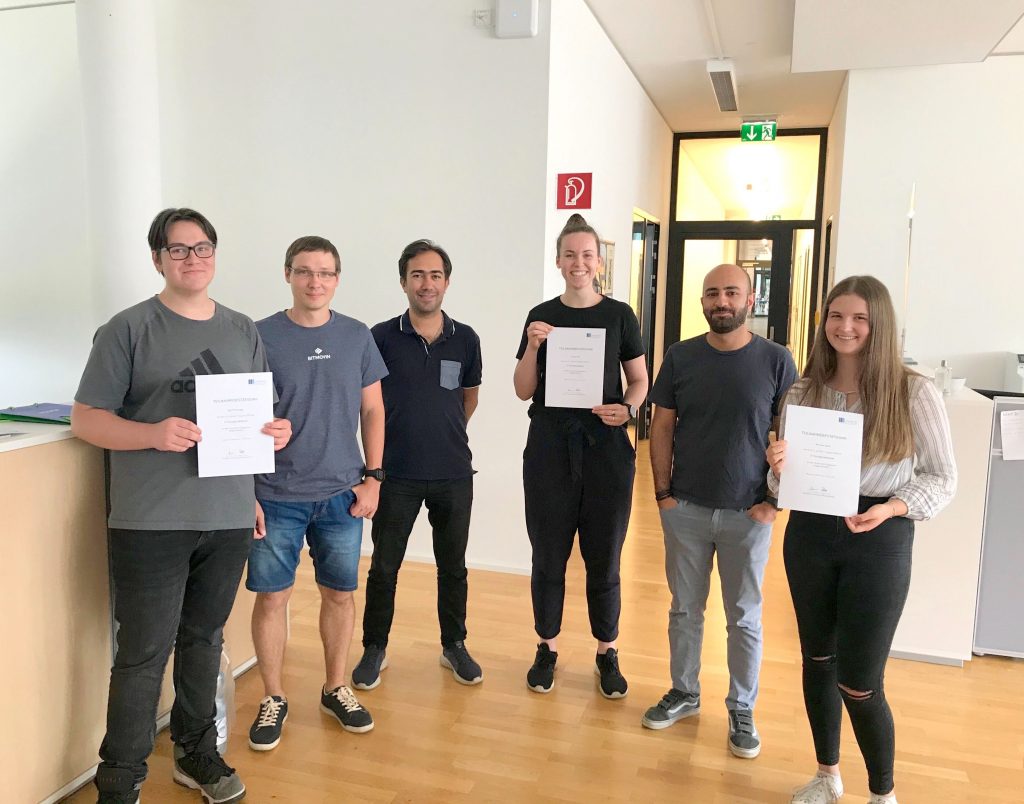
In July 2020, the ATHENA Christian Doppler Laboratory hosted three interns working on the following topics:

  • Indira Pal: Quality of Experience for HTTP Adaptive Streaming based use cases and scenarios.
  • Ilja Pronegg: Machine learning methods for HTTP Adaptive Streaming.
  • Miriam Gütl: State-of-the-art video streaming technologies.

At the end of the internship, the interns presented their work and the results in the form of a presentation and report. We believe that the joint work was useful both for the laboratory and for the interns themselves. We would like to thank the interns for their productive work, useful results, and excellent feedback about our laboratory.

Indira Pal: “I liked the internship very much and felt like a part of the team very soon. This was most likely due to the awesome atmosphere at the Christian Doppler laboratory. In my brief time at ATHENA, I was able to learn a lot about video compression and the challenges associated with this fairly widespread topic. Hadi was an excellent supervisor because he was always at the office and let me work independently while still providing assistance when I needed it. I enjoyed getting to know a Computer Scientist’s/Engineer’s work and now have a much clearer view of what a PhD student’s or Postdoc’s work looks like. I am very glad that I applied for this internship as I believe that my work at ATHENA was truly meaningful and I gained a lot from this experience.”

Miriam Gutl: “I really enjoyed every day of my internship at ATHENA and I am actually quite sad that the four weeks passed by so quickly. Already after the first day I felt so intergrated in the whole team which was so great for the whole atmosphere. In general the whole team was always so nice to us which was a real isperation. Also I would say that I have never learned so much in such a short periode of time till now. So I am really very thankfull that I was taken for this job it really did learned me a lot and in between it was also extremly fun. When I started looking for a internship I wanted something like that and I have actually found it at ATHENA so thank you.”

Ilja Pronegg:The internship was awesome! Everyone was nice and the topics I worked on were very interesting. I would make a second internship here!”

We wish the interns every success in their journey through life and we hope seeing them soon back at the University of Klagenfurt and ATHENA.

Posted in ATHENA | Comments Off on Interns at the ATHENA Christian Doppler Laboratory

Scalable High Efficiency Video Coding based HTTP Adaptive Streaming over QUIC

Scalable High Efficiency Video Coding based HTTP Adaptive Streaming over QUIC

Proceedings of the Workshop on the Evolution, Performance, and Interoperability of QUIC (EPIQ’20)

August 10 – 14, 2020 | New York, USA

[PDF][Slides][Video]

Minh Nguyen (AAU, Austria), Hadi Amirpour (AAU, Austria), Christian Timmerer (AAU, Austria), Hermann Hellwagner (AAU, Austria)

HTTP/2 has been explored widely for adaptive video streaming, but still suffers from Head-of-Line blocking, and three-way handshake delay due to TCP. Meanwhile, QUIC running on top of UDP can tackle these issues. In addition, although many adaptive bitrate (ABR) algorithms have been proposed for scalable and non-scalable video streaming, the literature lacks an algorithm designed for both types of video streaming approaches. In this paper, we investigate the impact of QUIC and HTTP/2 on the performance of ABR algorithms. Moreover, we propose an efficient approach for utilizing scalable video coding formats for adaptive video streaming that combines a traditional video streaming approach (based on non-scalable video coding formats) and a retransmission technique. The experimental results show that QUIC benefits significantly from our proposed method in the context of packet loss and retransmission. Compared to HTTP/2, it improves the average video quality and provides a smoother adaptation behavior. Finally, we demonstrate that our proposed method originally designed for non-scalable video codecs also works efficiently for scalable videos such as Scalable High Efficiency Video Coding (SHVC).

Posted in ATHENA | Comments Off on Scalable High Efficiency Video Coding based HTTP Adaptive Streaming over QUIC

ACM Multimedia’20: Relevance-Based Compression of Cataract Surgery Videos Using Convolutional Neural Networks

ACM International Conference on Multimedia 2020, Seattle, United States.

[PDF][Slides][Video]

Negin Ghamsarian (Alpen-Adria-Universität Klagenfurt), Hadi Amirpour (Alpen-Adria-Universität Klagenfurt), Christian Timmerer (Alpen-Adria-Universität Klagenfurt), Mario Taschwer (Alpen-Adria-Universität Klagenfurt), and Klaus Schöffmann (Alpen-Adria-Universität Klagenfurt)

Abstract: Recorded cataract surgery videos play a prominent role in training and investigating the surgery, and enhancing the surgical outcomes. Due to storage limitations in hospitals, however, the recorded cataract surgeries are deleted after a short time and this precious source of information cannot be fully utilized. Lowering the quality to reduce the required storage space is not advisable since the degraded visual quality results in the loss of relevant information that limits the usage of these videos. To address this problem, we propose a relevance-based compression technique consisting of two modules: (i) relevance detection, which uses neural networks for semantic segmentation and classification of the videos to detect relevant spatio-temporal information, and (ii) content-adaptive compression, which restricts the amount of distortion applied to the relevant content while allocating less bitrate to irrelevant content. The proposed relevance-based compression framework is implemented considering five scenarios based on the definition of relevant information from the target audience’s perspective. Experimental results demonstrate the capability of the proposed approach in relevance detection. We further show that the proposed approach can achieve high compression efficiency by abstracting substantial redundant information while retaining the high quality of the relevant content.

Keywords: Video Coding, Convolutional Neural Networks, HEVC, ROI Detection, Medical Multimedia.

https://www.slideshare.net/christian.timmerer/relevancebased-compression-of-cataract-surgery-videos-using-convolutional-neural-networks

Posted in ATHENA | Comments Off on ACM Multimedia’20: Relevance-Based Compression of Cataract Surgery Videos Using Convolutional Neural Networks