Christian Doppler laboratory ATHENA celebrates successful evaluation of its first research phase

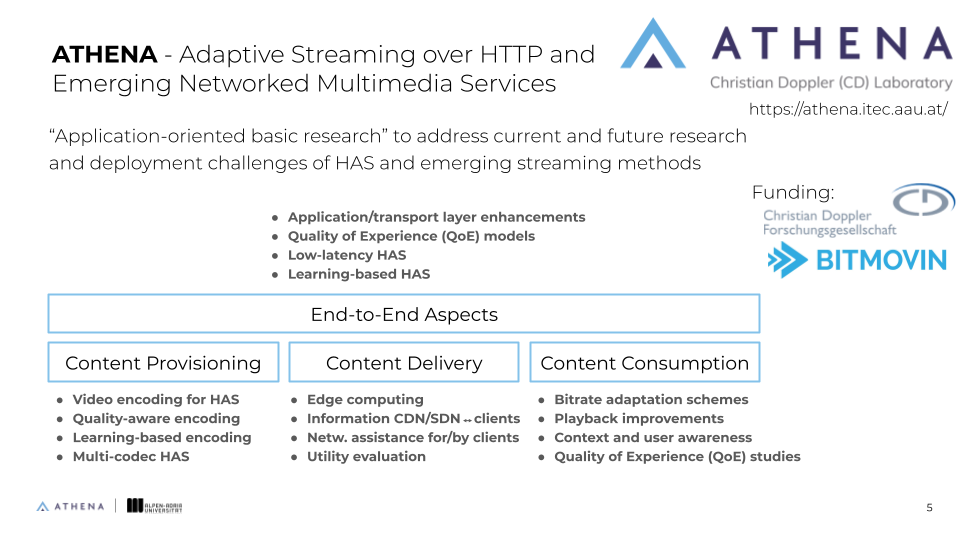
The Christian Doppler laboratory ATHENA (AdapTive Streaming over HTTP and Emerging Networked MultimediA Services) has been jointly proposed by the Institute of Information Technology (ITEC; https://itec.aau.at/) at Alpen-Adria-Universität Klagenfurt (AAU; https://www.aau.at) and Bitmovin GmbH (https://bitmovin.com) to address current and future research and deployment challenges of HTTP Adaptive Streaming (HAS) and emerging streaming methods. The aim of ATHENA is to research and develop novel paradigms, approaches, (prototype) tools, and evaluation results for the phases (1) multimedia content provisioning (WP-1), (2) content delivery (WP-2), and (3) content consumption (WP-3) in the media delivery chain as well as for (4) end-to-end aspects (WP-4), with a focus on, but not being limited to, HTTP Adaptive Streaming (HAS).

In this blog post, I’d like to briefly review how it started until the official review of the first phase in April 2021 that took place online. The result of this review is provided at the end.

ATHENA started in October 2019 with an international team of professors, Post-docs, Ph.D. students, and administrative personnel after an intensive hiring period from approx. February to December 2019. Additionally, we had to establish an entirely new office space from scratch (incl. planning thereof) as part of the Educational Lab of the Lakeside Science and Technology Park (due to space limitations of ITEC/AAU). Finally, the official opening event was celebrated as part of the 50-year celebration of AAU on January 21, 2020. Shortly after starting ATHENA, the COVID-19 pandemic reached also Austria and, thus, ATHENA, which significantly impacted our daily lives and work routines. The ATHENA team was required to switch to work-from-home (WFH) within one day including the management thereof, without prior experience in managing remote teams/individuals. However, ATHENA swiftly managed this transition thanks to ITEC administrative staff and Bitmovin who provided administrative support.

Despite all the issues caused by COVID-19, ATHENA was able to manage this extreme situation in a professional way leading to a number of publications in renowned publication venues. ATHENA was accepted as a pilot laboratory with the requirement to conduct application-oriented basic research according to the funding model of the Christian Doppler Gesellschaft (CDG). In this context, the ATHENA research resulted in various advances in adaptive streaming over HTTP and emerging networked multimedia services as outlined in the scientific part of this report. In particular, three journal publications with high impact/quality factor I and 17 conference/workshop publications with high quality factor I-II according to AAU’s internal ranking guidelines based on internationally recognized rankings (e.g., CORE). Furthermore, ATHENA contributed to a white paper on Definitions of Immersive Media Experience. Finally, various publications are currently in progress, i.e., under review/revision or to be submitted soon. The latest information about all ATHENA publications can be found here  (25 at the time of writing this blog post).

Christian Doppler laboratories are scientifically peer-reviewed regularly in between different phases of the project. The first review is typically done before the completion of the second year, and, thus, ATHENA has been reviewed in April 2021 (i.e., a bit earlier due to its ‘pilot’ status) based on the review report submitted in March 2021. This report included an overview of scientific contributions made during the first phase as well as a detailed research plan for the second phase of ATHENA. The actual review meeting was organized as an online meeting (due to COVID-19) comprising several administrative/overview presentations but also four technical presentations:

  • Video Coding for HTTP Adaptive Streaming: State of the Art, Recent Advances, and Future Perspectives
  • Network Assistance for HTTP Adaptive Streaming
  • H2BR: HTTP/2-based Segment Upgrading to Improve the Quality of Experience in HTTP Adaptive Streaming
  • QoE-Fairness in Low Latency Live Streaming

The Christian Doppler Research Association discussed the outcome of this ATHENA review in their meeting in June 2021. It is my pleasure to announce that the ATHENA CD ‘pilot’ lab is transferred into a regular CD lab starting October 2021 (i.e., received a successful, positive evaluation report) and that the budget for the second phase has been approved (i.e., Oct’21-Sep’24). I’d like to thank the CDG and the external reviewer for their valuable support and constructive feedback during this phase of ATHENA and I’m looking forward to an exciting and innovative second phase of the project. Finally, I’d like to thank the Alpen-Adria-Universität Klagenfurt, our industrial partner Bitmovin, and our ATHENA team for their tremendous efforts and contributions towards this first successful milestone. Stay tuned…

Posted in ATHENA | Comments Off on Christian Doppler laboratory ATHENA celebrates successful evaluation of its first research phase

Hadi Amirpour appointed co-chair of IMEx

Hadi Amirpour has been appointed co-chair of Task Force 7 (TF7) Immersive Media Experience (IMEx) at the 15th Qualinet meeting.

Co-chairs:

  • Hadi Amirpour (AAU)
  • Asim Hameed (NTNU)
  • Maria Torres Vega (UGhent)
  • Irene Viola, (CWI)

TF7: Immersive Media Experiences (IMEx)

Immersive media applications are entering our daily lives starting from VR/AR/360° video applications to multi-sensory/multimedia experiences potentially addressing all human senses rather than focusing on hearing and seeing. The overall goal of providing Immersive Media Experiences (IMEx) to end-users is giving them the sensation of being part of the particular media which shall result in a worthwhile, informative user and quality of experience.

The actual objectives of this task force are as follows:

  • disseminating the white paper
  • working towards submission of the extended version
  • liaison with other communities (UX, sensory sciences) and standards developing organizations (JPEG, MPEG, EBU)
  • Identification of different QoE aspects of immersive experiences
  • QoE models and QoE assessment approaches for immersive experiences, addressing various audiovisual modalities; e.g., HDR, omnidirectional video, light fields, point clouds and spatial audio.
Posted in ATHENA | Comments Off on Hadi Amirpour appointed co-chair of IMEx

Christian Timmerer to give a Keynote at the 35th Picture Coding Symposium 2021

HTTP Adaptive Streaming – Quo Vadis?

Christian Timmerer, Tuesday, June 29, 2021

https://pcs2021.org/

Abstract: Video traffic on the Internet is constantly growing; networked multimedia applications consume a predominant share of the available Internet bandwidth. A major technical breakthrough and enabler in multimedia systems research and of industrial networked multimedia services certainly was the HTTP Adaptive Streaming (HAS) technique. This resulted in the standardization of MPEG Dynamic Adaptive Streaming over HTTP (MPEG-DASH) which, together with HTTP Live Streaming (HLS), is widely used for multimedia delivery in today’s networks. Existing challenges in multimedia systems research deal with the trade-off between (i) the ever-increasing content complexity, (ii) various requirements with respect to time (most importantly, latency), and (iii) quality of experience (QoE). Optimizing towards one aspect usually negatively impacts at least one of the other two aspects if not both.



This situation sets the stage for our research work in the ATHENA Christian Doppler (CD) Laboratory (Adaptive Streaming over HTTP and Emerging Networked Multimedia Services; https://athena.itec.aau.at/), jointly funded by public sources and industry.

In this talk, we will present selected novel approaches and research results of the first year of the ATHENA CD Lab’s operation. We will highlight HAS-related research on: (i) multimedia content provisioning (machine learning for video encoding); (ii) multimedia content delivery (support of edge processing and virtualized network functions for video networking); (iii) multimedia content consumption and end-to-end aspects (player-triggered segment retransmissions to improve video playout quality); and (iv) novel QoE investigations (adaptive point cloud streaming). We will also put the work into the context of the international multimedia systems research.

https://www.slideshare.net/christian.timmerer/http-adaptive-streaming-quo-vadis

Posted in ATHENA | Comments Off on Christian Timmerer to give a Keynote at the 35th Picture Coding Symposium 2021

Efficient Content-Adaptive Feature-based Shot Detection for HTTP Adaptive Streaming

IEEE International Conference on Image Processing (ICIP)

September 19-22, 2021, Alaska, USA

[PDF] [Video] [Poster]

Vignesh V Menon (Alpen-Adria-Universität Klagenfurt),  Hadi Amirpour (Alpen-Adria-Universität Klagenfurt), Mohammad Ghanbari (School of Computer Science and Electronic Engineering, University of Essex, Colchester, UK), and Christian Timmerer (Alpen-Adria-Universität Klagenfurt).

Abstract:

Video delivery over the Internet has been becoming a commodity in recent years, owing to the widespread use of DASH. The DASH specification defines a hierarchical data model for Media Presentation Descriptions (MPDs) in terms of segments. This paper focuses on segmenting video into multiple shots for encoding in  VoD HAS applications.
This paper proposes a novel DCT feature-based shot detection and successive elimination algorithm for shot detection algorithm and benchmark the algorithm against the default shot detection algorithm of the x265 implementation of the HEVC standard. Our experimental results demonstrate that the proposed feature-based pre-processor has a recall rate of 25% and an F-measure of 20% greater than the benchmark algorithm for shot detection.

Keywords: HTTP Adaptive Streaming, Video-on-Demand, Shot detection, multi-shot encoding.

Posted in ATHENA | Comments Off on Efficient Content-Adaptive Feature-based Shot Detection for HTTP Adaptive Streaming

IEEE OJ-SP: Fast Multi-Resolution and Multi-Rate Encoding for HTTP Adaptive Streaming Using Machine Learning

Fast Multi-Resolution and Multi-Rate Encoding for HTTP Adaptive Streaming Using Machine Learning

IEEE Open Journal of Signal Processing

https://signalprocessingsociety.org/publications-resources/ieee-open-journal-signal-processing

[PDF]

Ekrem Çetinkaya (Christian Doppler Laboratory ATHENA, Alpen-Adria-Universität Klagenfurt), Hadi Amirpour, (Christian Doppler Laboratory ATHENA, Alpen-Adria-Universität Klagenfurt), Christian Timmerer (Christian Doppler Laboratory ATHENA, Alpen-Adria-Universität Klagenfurt), and Mohammad Ghanbari (Christian Doppler Laboratory ATHENA, Alpen-Adria-Universität Klagenfurt, University of Essex)

Abstract: Video streaming applications keep getting more attention over the years, and HTTP Adaptive Streaming (HAS) became the de-facto solution for video delivery over the Internet. In HAS, each video is encoded at multiple quality levels and resolutions (i.e., representations) to enable adaptation of the streaming session to viewing and network conditions of the client. This requirement brings encoding challenges along with it, e.g., a video source should be encoded efficiently at multiple bitrates and resolutions. Fast multi-rate encoding approaches aim to address this challenge of encoding multiple representations from a single video by re-using information from already encoded representations. In this paper, a convolutional neural network is used to speed up both multi-rate and multi-resolution encoding for HAS. For multi-rate encoding, the lowest bitrate representation is chosen as the reference. For multi-resolution encoding, the highest bitrate from the lowest resolution representation is chosen as the reference. Pixel values from the target resolution and encoding information from the reference representation are used to predict Coding Tree Unit (CTU) split decisions in High-Efficiency Video Coding (HEVC) for dependent representations. Experimental results show that the proposed method for multi-rate encoding can reduce the overall encoding time by 15.08% and parallel encoding time by 41.26%, with a 0.89% bitrate increase compared to the HEVC reference software. Simultaneously, the proposed method for multi-resolution encoding can reduce the encoding time by 46.27% for the overall encoding and 27.71% for the parallel encoding on average with a 2.05% bitrate
increase.

Keywords: HTTP Adaptive Streaming, HEVC, Multirate Encoding, Machine Learning

Posted in ATHENA | Comments Off on IEEE OJ-SP: Fast Multi-Resolution and Multi-Rate Encoding for HTTP Adaptive Streaming Using Machine Learning

Call for Papers for a MobiSys Workshop

Students in MobiSys (SMS)

In Conjugation with MobiSys 2021

June 26, 2021, Mars, Solar System, Milky Way

Workshop Chairs:

  • Hannaneh Barahouei Pasandi, Virginia Commonwealth University
  • Mallesham Dasari, Stony Brook University
  • Hadi Amirpour, University of Klagenfurt

Students Workshop in MobiSys (SMS): The SMS workshop provides a unique venue for graduate students around the world to discuss research ideas for mobile and wireless systems. The workshop is organized by a student-run TPC. SMS workshop aims to foster early-career development among students, expose them to the workings of academic life, and encourage student leadership and participation in the research community. SMS 2021 will be held in conjunction with MobiSys 2021 .


SMS Workshop provides a unique venue for graduate students around the world to present, discuss, and exchange ideas on cross-cutting research on mobile wireless networks. As its name suggests, the workshop is organized by students, and the technical sessions are given by student presenters. Submissions must be first-authored by a student. The workshop aims at fostering early-career development among students and exposing them to the workings of academic life. It provides a venue for students to learn about each others’ work and discover opportunities for collaboration.

Topics of interest include, but are not limited to:

  • Experience with mobile applications, networks, and systems
  • Innovative mobile, mobile sensing, and mobile crowdsourcing applications
  • Tools for building and measuring mobile systems
  • Innovative wearable or mobile devices
  • Novel software architectures for mobile devices and mobile computing
  • Data management for mobile applications
  • Infrastructure support for mobile computing
  • System-level energy management for mobile devices
  • Operating systems for mobile devices
  • Support for mobile social networking and the mobile web
  • Security and privacy in mobile systems
  • Resource-efficient machine learning and AI for mobile devices
  • Systems for location and context sensing and awareness
  • Mobile computing support for pervasive computing Vehicular and mobile robotic systems
  • Systems and networking support for virtual or augmented reality
  • Applications of mobile systems in health, sustainability, and smart cities
  • Satellites Communication and networks
  • Architectures, protocols, and algorithms in mobile network
  • Measurements of mobile and network ecosystems
  • Mobile data science & analysis
  • Sensing using mobile phones, wearables, robots, quad-copters, crowd-sourcing etc
  • Operating system and middle-ware support for mobile computing and networking
  • Modeling, measurement and simulation of mobile networks
  • Applications of machine learning to mobile/wireless research
  • Mobile web, video, AR/VR/Immersive reality, and other applications
  • User interfaces, experience, and usability for mobile applications and systems
  • Data management for mobile and wireless systems

The workshop invites students to submit papers, posters, and demos through the following hotcrp link: https://sms2021.hotcrp.com/ . All submissions will be peer-reviewed by the student TPC. We encourage students with a paper, poster, or demo at ACM MobiSys main conference to present their work at SMS as well. Please contact the TPC co-chairs at  sms.mobisys@gmail.com  for any queries.

Important Dates

  • Submission Deadline: June 04, 2021
  • Acceptance Notifications: June 08, 2021
  • Camera Ready Deadline: June 11, 2021
Posted in ATHENA | Comments Off on Call for Papers for a MobiSys Workshop

Efficient Multi-Encoding Algorithms for HTTP Adaptive Bitrate Streaming

Efficient Multi-Encoding Algorithms for HTTP Adaptive Bitrate Streaming

Picture Coding Symposium (PCS)

29 June-2 July 2021, Bristol, UK

[PDF][Slides][Video]

Vignesh V Menon (Alpen-Adria-Universität Klagenfurt),  Hadi Amirpour (Alpen-Adria-Universität Klagenfurt), Christian Timmerer (Alpen-Adria-Universität Klagenfurt), and Mohammad Ghanbari (School of Computer Science and Electronic Engineering, University of Essex, Colchester, UK)

Abstract:

Since video accounts for the majority of today’s internet traffic, the popularity of HTTP Adaptive Streaming (HAS) is increasing steadily. In HAS, each video is encoded at multiple bitrates and spatial resolutions (i.e., representations) to adapt to a heterogeneity of network conditions, device characteristics, and end-user preferences. Most of the streaming services utilize cloud-based encoding techniques which enable a fully parallel encoding process to speed up the encoding and consequently to reduce the overall time complexity. State-of-the-art approaches further improve the encoding process by utilizing encoder analysis information from already encoded representation(s) to improve the encoding time complexity of the remaining representations. In this paper, we investigate various multi-encoding algorithms (i.e., multi-rate and multi-resolution) and propose novel multi- encoding algorithms for large-scale HTTP Adaptive Streaming deployments. Experimental results demonstrate that the proposed multi-encoding algorithm optimized for the highest compression efficiency reduces the overall encoding time by 39% with a 1.5% bitrate increase compared to stand-alone encodings. Its optimized version for the highest time savings reduces the overall encoding time by 50% with a 2.6% bitrate increase compared to stand-alone encodings.

Keywords: HTTP Adaptive Streaming, HEVC, Multi-rate Encoding, Multi-encoding.

https://www.slideshare.net/christian.timmerer/efficient-multiencoding-algorithms-for-http-adaptive-bitrate-streaming

Posted in ATHENA | Comments Off on Efficient Multi-Encoding Algorithms for HTTP Adaptive Bitrate Streaming