Roland Matha´∗, Dragi Kimovski*, Anatoliy Zabrovskiy*‡, Christian Timmerer*†, Radu Prodan*
Institute of Information Technology (ITEC), University of Klagenfurt, Austria*
Bitmovin, Klagenfurt, Austria†
Petrozavodsk State University, Petrozavodsk, Russia‡
Abstract: Video streaming became an undivided part of the Internet. To efficiently utilise the limited network bandwidth it is essential to encode the video content. However, encoding is a computationally intensive task, involving high-performance resources provided by private infrastructures or public clouds. Public clouds, such as Amazon EC2, provide a large portfolio of services and instances optimized for specific purposes and budgets. The majority of Amazon’s instances use x86 processors, such as Intel Xeon or AMD EPYC. However, following the recent trends in computer architecture, Amazon introduced Arm based instances that promise up to 40% better cost performance
ratio than comparable x86 instances for specific workloads. We evaluate in this paper the video encoding performance of x86 and Arm instances of four instance families using the latest FFmpeg version and two video codecs. We examine the impact of the encoding parameters, such as different presets and bitrates, on the time and cost for encoding. Our experiments reveal that Arm instances show high time and cost saving potential of up to
33.63% for specific bitrates and presets, especially for the x264 codec. However, the x86 instances are more general and achieve low encoding times, regardless of the codec.
Index Terms—Amazon EC2, Arm instances, AVC, Cloud computing, FFmpeg, Graviton2, HEVC, Performance analysis, Video encoding.
IEEE Global Communications Conference 2021
7-11 December 2021 // Madrid, Spain // Hybrid: In-Person and Virtual Conference
Connecting Cultures around the Globe https://globecom2021.ieee-globecom.org/
F. Tashtarian*, R. Falanji‡, A. Bentaleb+, A. Erfanian*, P. S. Mashhadi§,
C. Timmerer*, H. Hellwagner*, R. Zimmermann+
Christian Doppler Laboratory ATHENA, Institute of Information Technology, Alpen-Adria-Universität Klagenfurt, Austria*
Department of Mathematical Science, Sharif University of Technology, Tehran, Iran‡
Department of Computer Science, School of Computing, National University of Singapore (NUS)+
Center for Applied Intelligent Systems Research (CAISR), Halmstad University, Sweden§
Abstract: Recent years have seen tremendous growth in HTTP adaptive live video traffic over the Internet. In the presence of highly dynamic network conditions and diverse request patterns, existing yet simple hand-crafted heuristic approaches for serving client requests at the network edge might incur a large overhead and significant increase in time complexity. Therefore, these approaches might fail in delivering acceptable Quality of Experience (QoE) to end users. To bridge this gap, we propose ROPL, a learning-based client request management solution at the edge that leverages the power of the recent breakthroughs in deep reinforcement learning, to serve requests of concurrent users joining various HTTP-based live video channels. ROPL is able to react quickly to any changes in the environment, performing accurate decisions to serve clients requests, which results in achieving satisfactory user QoE. We validate the efficiency of ROPL through trace-driven simulations and a real-world setup. Experimental results from real-world scenarios confirm that ROPL outperforms existing heuristic-based approaches in terms of QoE, with a factor up to 3.7×.
Index Terms—Network Edge; Request Serving; HTTP Live Streaming; Low Latency; QoE; Deep Reinforcement Learning.
Details: The Meetup will be streamed on Twitch on the Demuxed channel: https://www.twitch.tv/demuxed – there will also be a video call afterwards for anyone who wants to hang around, have a drink, and chat!
Posted inATHENA|Comments Off on Hadi Amirpour will give a talk at London Video Tech
Abstract: Exponential growth in multimedia streaming traffic over the Internet motivates the research and further investigation of the user’s perceived quality of such services. Enhancement of experienced quality by the users becomes more substantial when service providers compete on establishing superiority by gaining more subscribers or customers. Quality of Experience (QoE) enhancement would not be possible without an authentic and accurate assessment of the streaming sessions. HTTP Adaptive Streaming (HAS) is today’s prevailing technique to deliver the highest possible audio and video content quality to the users. An end-to-end evaluation of QoE in HAS covers the precise measurement of the metrics that affect the perceived quality, eg. startup delay, stall events, and delivered media quality. Mentioned metrics improvements could limit the service’s scalability, which is an important factor in real-world scenarios. In this study, we will investigate the stated metrics, best practices and evaluations methods, and available techniques with an aim to (i) design and develop practical and scalable measurement tools and prototypes, (ii) provide a better understanding of current technologies and techniques (eg. Adaptive Bitrate algorithms), (iii) conduct in-depth research on the significant metrics in a way that improvements of QoE with scalability in mind would be feasible, and finally, (iv) provide a comprehensive QoE model which outperforms state-of-the-art models.
Ekrem Çetinkaya* (Christian Doppler Laboratory ATHENA, Alpen-Adria-Universität Klagenfurt), Hadi Amirpour*, (Christian Doppler Laboratory ATHENA, Alpen-Adria-Universität Klagenfurt), Mohammad Ghanbari (Christian Doppler Laboratory ATHENA, University of Essex), and Christian Timmerer (Christian Doppler Laboratory ATHENA, Alpen-Adria-Universität Klagenfurt)
*These authors contributed equally to this work.
Abstract: High Efficiency Video Coding (HEVC) surpasses its predecessors in encoding efficiency by introducing new coding tools at the cost of an increased encoding time-complexity. The Coding Tree Unit (CTU) is the main building block used in HEVC. In the HEVC standard, frames are divided into CTUs with the predetermined size of up to 64 × 64 pixels. Each CTU is then divided recursively into a number of equally sized square areas, known as Coding Units (CUs). Although this diversity of frame partitioning increases encoding efficiency, it also causes an increase in the time complexity due to the increased number of ways to find the optimal partitioning. To address this complexity, numerous algorithms have been proposed to eliminate unnecessary searches during partitioning CTUs by exploiting the correlation in the video. In this paper, existing CTU depth decision algorithms for HEVC are surveyed. These algorithms are categorized into two groups, namely statistics and machine learning approaches. Statistics approaches are further subdivided into neighboring and inherent approaches. Neighboring approaches exploit the similarity between adjacent CTUs to limit the depth range of the current CTU, while inherent approaches use only the available information within the current CTU. Machine learning approaches try to extract and exploit similarities implicitly. Traditional methods like support vector machines or random forests use manually selected features, while recently proposed deep learning methods extract features during training. Finally, this paper discusses extending these methods to more recent video coding formats such as Versatile Video Coding (VVC) and AOMedia Video 1 (AV1).
Keywords:HEVC, Coding Tree Unit, Complexity, CTU Partitioning, Statistics, Machine Learning
Posted inATHENA|Comments Off on CTU Depth Decision Algorithms for HEVC: A Survey
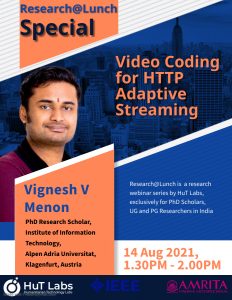
Vignesh V Menon is invited to talk on “Video Coding for HTTP Adaptive Streaming” on the Research@Lunch, which is a research webinar series by Humanitarian Technology (HuT) Labs, Amrita Vishwa Vidyapeetham University, India, exclusively for Ph.D. Scholars, UG, and PG Researchers in India. This talk will introduce the basics of video codecs and highlight the scope of HAS-related research on video encoding.
Time: August 14, 10.00AM-10.30AM (CEST) or 1.30PM- 2.00PM (IST)
Abstract: Video streaming has become one of the most prevailing, bandwidth-hungry, and latency-sensitive Internet applications. HTTP Adaptive Streaming (HAS) has become the dominant video delivery mechanism over the Internet. Lack of coordination among the clients and lack of awareness of the network in pure client-based adaptive video bitrate approaches have caused problems, such as sub-optimal data throughput from Content Delivery Network (CDN) or origin servers, high CDN costs, and non-satisfactory users’ experience. Recent studies have shown that network-assisted HAS techniques by utilizing modern networking paradigms, e.g., Software-Defined Networking (SDN), Network Function Virtualization (NFV), and edge computing can significantly improve HAS system performance. In this doctoral study, we leverage the aforementioned modern networking paradigms and design network assistance for/by HAS clients to improve HAS systems performance and CDN/network utilization. We present four fundamental research questions to target different challenges in devising a network-assisted HAS system.
Machine Learning Based Video Coding Enhancements for HTTP Adaptive Streaming
Abstract: Video traffic comprises the majority of today’s Internet traffic, and HTTP Adaptive Streaming (HAS) is the preferred method to deliver video content over the Internet. Increasing demand for video and the improvements in the video display conditions over the years caused an increase in the video coding complexity. This increased complexity brought the need for more efficient video streaming and coding solutions. The latest standard video codecs can reduce the size of the videos by using more efficient tools with higher time-complexities. The plans for integrating machine learning into upcoming video codecs raised the interest in applied machine learning for video coding. In this doctoral study, we aim to propose applied machine learning methods to video coding, focusing on HTTP adaptive streaming. We present four primary research questions to target different challenges in video coding for HTTP adaptive streaming.
Abstract: Video streaming is the most used service in mobile networks and its usage will continue growing in the upcoming years. Due to this increase, content delivery should be improved as a key aspect of video streaming service, supporting higher bandwidth demand while assuring high quality of experience (QoE) for all the users. Multi-access edge computing (MEC) is an emerging paradigm that brings computational power and storage closer to the user. It is seen in the industry as a key technology for 5G mobile networks, with the goals of reducing latency, ensuring highly efficient network operation, improving service delivery and offering an improved user experience, among others. In this doctoral study, we aim to leverage the possibilities of MEC to improve the content delivery of video streaming services. We present four main research questions to target the different challenges in content delivery for HTTP Adaptive Streaming.
Optimizing QoE and Latency of Live Video Streaming Using Edge Computing and In-Network Intelligence
Abstract: Live video streaming traffic and related applications have experienced significant growth in recent years. More users have started generating and delivering live streams with high quality (e.g., 4K resolution) through popular online streaming platforms such as YouTube, Twitch, and Facebook. Typically, the video contents are generated by streamers and watched by many audiences, which are geographically distributed in various locations far away from the streamers’ locations. The resource limitation in the network (e.g., bandwidth) is a challenging issue for network and video providers to meet the users’ requested quality. In this thesis, we will investigate optimizing QoE and end-to-end (E2E) latency of live video streaming by leveraging edge computing capabilities and in-network intelligence. We present four main research questions aiming to address the various challenges in optimizing live streaming QoE and E2E latency by employing edge computing and in-network intelligence.
Policy-driven Dynamic HTTP Adaptive Streaming Player Environment
Abstract: Video streaming services account for the majority of today’s traffic on the Internet. Although the data transmission rate has been increasing significantly, the growing number and variety of media and higher quality expectations of users have led networked media applications to fully or even over-utilize the available throughput. HTTP Adaptive Streaming (HAS) has become a predominant technique for multimedia delivery over the Internet today. However, there are critical challenges for multimedia systems, especially the tradeoff between the increasing content (complexity) and various requirements regarding time (latency) and quality (QoE). This thesis will cover the main aspects within the end user’s environment, including video consumption and interactivity, collectively referred to as player environment, which is probably the most crucial component in today’s multimedia applications and services. We will investigate the methods that can enable the specification of various policies reflecting the user’s needs in given use cases. Besides, we will also work on schemes that allow efficient support for server-assisted, and network-assisted HAS systems. Finally, those approaches will be considered to combine into policies that fit the requirements of all use cases (e.g., live streaming, video on demand, etc.).
Posted inATHENA|Comments Off on ATHENA Papers Accepted at ACM MMSys’21 Doctoral Symposium

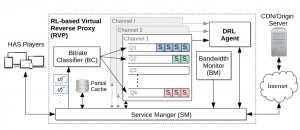 Internet. In the presence of highly dynamic network conditions and diverse request patterns, existing yet simple hand-crafted heuristic approaches for serving client requests at the network edge might incur a large overhead and significant increase in time complexity. Therefore, these approaches might fail in delivering acceptable Quality of Experience (QoE) to end users. To bridge this gap, we propose ROPL, a learning-based client request management solution at the edge that leverages the power of the recent breakthroughs in deep reinforcement learning, to serve requests of concurrent users joining various HTTP-based live video channels. ROPL is able to react quickly to any changes in the environment, performing accurate decisions to serve clients requests, which results in achieving satisfactory user QoE. We validate the efficiency of ROPL through trace-driven simulations and a real-world setup. Experimental results from real-world scenarios confirm that ROPL outperforms existing heuristic-based approaches in terms of QoE, with a factor up to 3.7×.
 Hadi Amirpour is invited to give a talk on “(Scalable) Light Field Coding” in London Video Tech. This talk will include: