Residual U-Network: 3D Point Cloud-Based Automotive Pressure Field Prediction Model
18th International Congress on Image and Signal Processing, BioMedical Engineering, and Informatics (CISP-BMEI 2025)
October 25 – 27, 2025
Qingdao, China
http://www.cisp-bmei.cn/
[PDF]
Hezhi Li, Hongyou Chen, Lingfeng Qu, Baodan Tian, Yong Fan, Hadi Amirpour, and Christian Timmerer
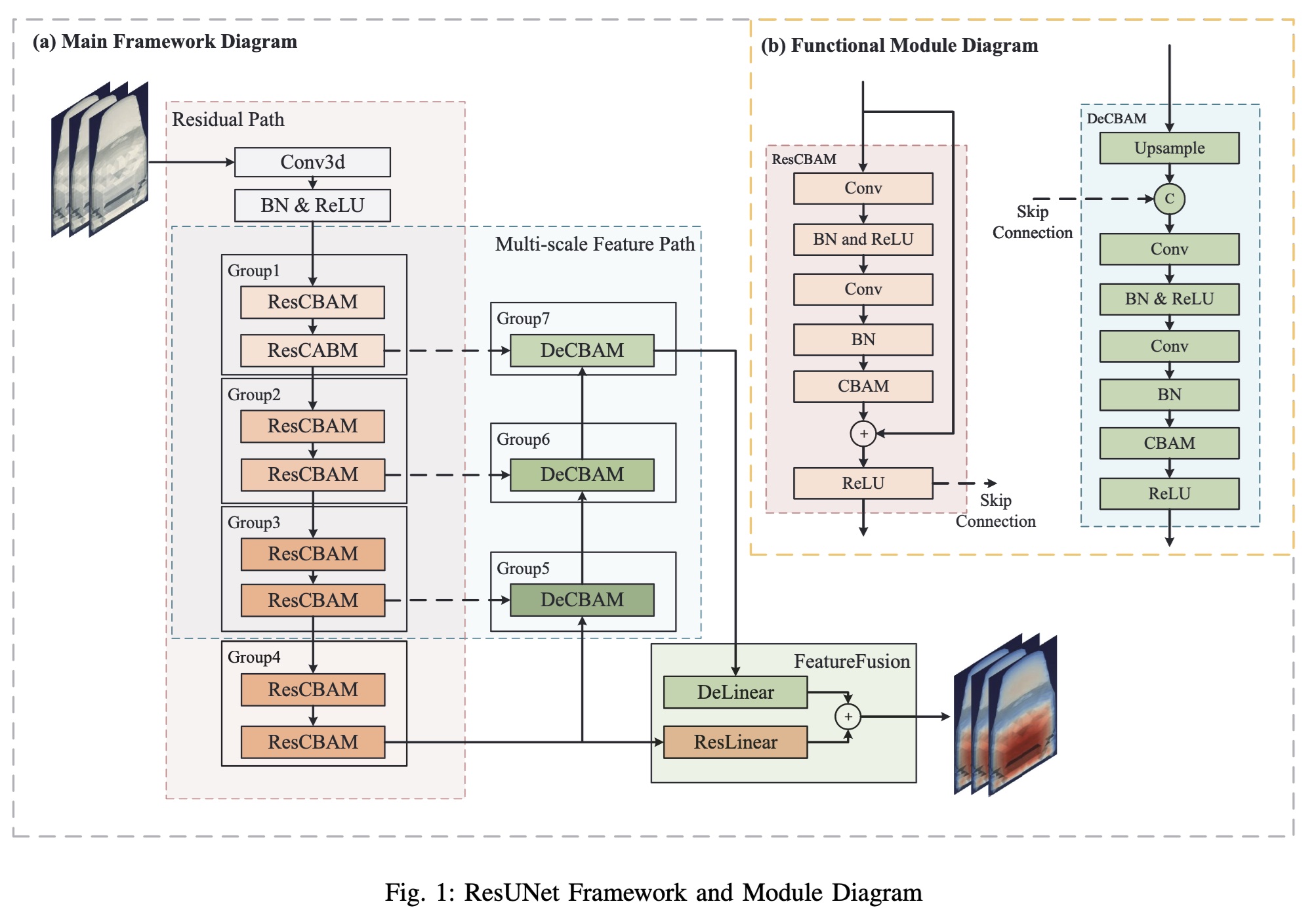
Abstract: Automotive surface pressure field prediction is important for design optimization and performance evaluation of vehicle aerodynamics, fuel efficiency, and automotive safety. Although traditional computational fluid dynamics methods are accurate, they incur high computational costs and are time-consuming. Most existing deep learning methods show limitations in learning pressure variation features near complex geometric shapes of automotive exteriors. To address these issues, this paper proposes a deep learning method based on a hybrid architecture combining Residual Network (ResNet) and U-Network (UNet). The method processes 3D point cloud representations of automotive geometries by converting them into structured grid formats with signed distance function values for efficient neural network processing. The method improves the model’s predictive capability for complex geometric regions by integrating the Convolutional Block Attention Module (CBAM) attention mechanism. In the model, the Residual Convolutional Block Attention Module (ResCBAM) combines residual connections with channel and spatial attention mechanisms to improve perception of key pressure field features. The Decoder Convolutional Block Attention Module (DeCBAM) fuses multi-scale feature information in the decoder pathway, recovering neural network feature details. The feature fusion module integrates global flow field distribution features extracted by the encoder with local geometric detail features reconstructed by the decoder. Additionally, an automated hyperparameter optimization strategy is employed to improve the model’s prediction accuracy and generalization capability. To validate model performance, experiments are conducted on three automotive surface pressure datasets. Experimental results demonstrate that the proposed model achieves better prediction accuracy and generalization capability.