Klagenfurt, July 31, 2025
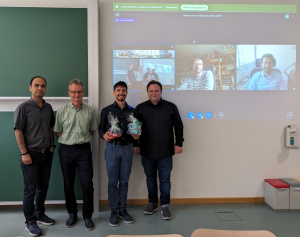
Congratulations to Dr. Daniele Lorenzi for successfully defending his dissertation on “QoE- and Energy-aware Content Consumption for HTTP Adaptive Streaming” at Universität Klagenfurt in the context of the Christian Doppler Laboratory ATHENA.
Abstract
HTTP Adaptive Streaming (HAS) has become the dominant paradigm for video delivery over the Internet, enabling scalable and flexible content consumption across heterogeneous networks and devices. The continuous growth of video traffic, coupled with the increasing complexity of multimedia content and the proliferation of resource-constrained devices, poses significant challenges for streaming systems. In particular, service providers and researchers must jointly address Quality of Experience (QoE), energy consumption, and emerging protocol and content technologies to meet user expectations while ensuring sustainable operation.
This dissertation investigates QoE- and energy-aware content consumption in HAS, with a primary focus on client-side adaptation mechanisms. Through a systematic analysis of existing approaches, the thesis identifies key limitations in current Adaptive Bitrate (ABR) algorithms, which often prioritize bitrate maximization without sufficiently considering perceptual quality, energy efficiency, codec diversity, or new networking capabilities. To address these challenges, the dissertation proposes a set of novel methodologies, algorithms, and datasets that jointly optimize QoE and energy consumption under realistic network and device constraints.
The first contribution explores the exploitation of emerging transport protocols, specifically HTTP/3 and QUIC, to enhance QoE in HAS. The proposed DoFP+ approach leverages advanced protocol features such as stream multiplexing, prioritization, and termination to upgrade previously downloaded low-quality segments during playback. Extensive experimental evaluations demonstrate significant QoE improvements, reduced stall events, and more efficient bandwidth utilization compared to state-of-the-art approaches.
As a second contribution, the dissertation addresses the limitations of single-codec streaming by introducing MEDUSA, a dynamic multi-codec ABR approach. MEDUSA enables per-segment codec selection based on content-aware perceptual quality and segment size information, allowing the system to adapt to varying content complexity over time. Results show that dynamic codec switching can substantially improve perceptual quality while reducing transmitted data volume, thereby benefiting both end users and streaming providers.
The third contribution focuses on sustainable video streaming through energy-aware adaptation. The thesis introduces E-WISH, an energy-aware ABR algorithm that incorporates an explicit energy consumption model into the quality selection process, reducing playback stalls and lowering power usage without compromising QoE. To support systematic energy evaluations, the dissertation further presents COCONUT, a comprehensive dataset of fine-grained energy measurements collected from multiple client devices. This dataset enables in-depth analysis of the impact of video, device, and network parameters on energy consumption in HAS.
Finally, the dissertation investigates neural-enhanced streaming (NES), where client-side machine learning techniques are used to improve visual quality at the cost of additional computational overhead. To balance QoE gains and power consumption in heterogeneous client environments, the thesis proposes Receptive, a coordinated system that jointly optimizes ABR decisions and neural enhancement strategies across multiple users. Experimental results demonstrate that Receptive achieves substantial QoE improvements while significantly reducing energy consumption on NES-capable devices.
Overall, this dissertation advances the state of the art in HTTP Adaptive Streaming by introducing protocol-aware, content-aware, and energy-aware adaptation mechanisms, complemented by realistic datasets and comprehensive evaluations. The presented contributions provide a solid foundation for future research and practical deployments aiming to deliver high-quality, energy-efficient, and sustainable video streaming services.
Slides are available here.