Network-Assisted Adaptive Streaming: Toward Optimal QoE through System Collaboration
Farzad Tashtarian
Habilitation
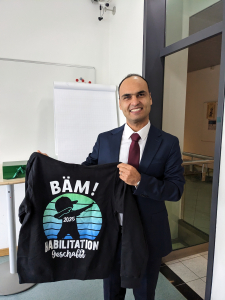
On 14.11.2025, Farzad Tashtarian defended his habilitation “Network-Assisted Adaptive Streaming: Toward Optimal QoE through System Collaboration” at the University of Klagenfurt, Austria.

Abstract: Providing seamless, low-latency, and energy-efficient video streaming experiences remains an ongoing challenge as content delivery infrastructures evolve to support higher resolutions, immersive formats, and heterogeneous networks. This talk explores an end-to-end perspective on network-assisted adaptive streaming, where close coordination between the player, network, and edge/cloud components enables data-driven and context-aware optimization. It will discuss adaptive bitrate algorithm design, cost- and delay-conscious edge transcoding, and multi-objective optimization across the streaming pipeline. Emerging AI-based methods—such as reinforcement learning, generative modeling, and large language model (LLM) orchestration—will be highlighted as key enablers for intelligent and self-adjusting video delivery. The talk concludes with a discussion of open challenges, scalability, and future research directions toward resilient, efficient, and user-centric streaming infrastructures.
Committee members: Prof. Martin Pinzger (Chairperson), Prof. Oliver Hohlfeld (external member), Prof. Bernhard Rinner, Prof. Angelika Wiegele, Prof. Chitchanok Chuengsatiansup, MSc Zoha Azimi Ourimi, Dr. Alice Tarzariol, Kateryna Taranov, and Gregor Lammer