We are happy to announce and our congratulations to Dr. Hermann Hellwagner for receiving the appreciation award of Carinthia in the area of natural/technical sciences.
We are happy to announce and our congratulations to Dr. Hermann Hellwagner for receiving the appreciation award of Carinthia in the area of natural/technical sciences.
[PDF]
Babak Taraghi (AAU, Austria), Selina Zoë Haack (AAU, Austria), and Christian Timmerer (AAU, Austria)
Abstract: HTTP Adaptive Streaming (HAS) is nowadays a popular solution for multimedia delivery. The novelty of HAS lies in the possibility of continuously adapting the streaming session to current network conditions, facilitated by Adaptive Bitrate (ABR) algorithms. Various popular streaming and Video on Demand services such as Netflix, Amazon Prime Video, and Twitch use this method. Given this broad consumer base, ABR algorithms continuously improve to increase user satisfaction. The insights for these improvements are, among others, gathered within the research area of Quality of Experience (QoE). Within this field, various researchers have dedicated their works to identifying potential impairments and testing their impact on viewers’ QoE. Two frequently discussed visual impairments influencing QoE are stalling events and quality switches. So far, it is commonly assumed that those stalling events have the worst impact on QoE. This paper challenged this belief and reviewed this assumption by comparing stalling events with multiple quality and high amplitude quality switches. Two subjective studies were conducted. During the first subjective study, participants received a monetary incentive, while the second subjective study was carried out with volunteers. The statistical analysis demonstrated that stalling events do not result in the worst degradation of QoE. These findings suggest that a reevaluation of the effect of stalling events in QoE research is needed. Therefore, these findings may be used for further research and to improve current adaptation strategies in ABR algorithms.
Reza Farahani (Alpen-Adria-Universität Klagenfurt, Austria), Mohammad Shojafar (University of Surrey, UK), Christian Timmerer (Alpen-Adria-Universität Klagenfurt, Austria), Farzad Tashtarian (Alpen-Adria-Universität Klagenfurt, Austria), Mohammad Ghanbari (University of Essex, UK), and Hermann Hellwagner (Alpen-Adria-Universität Klagenfurt, Austria)
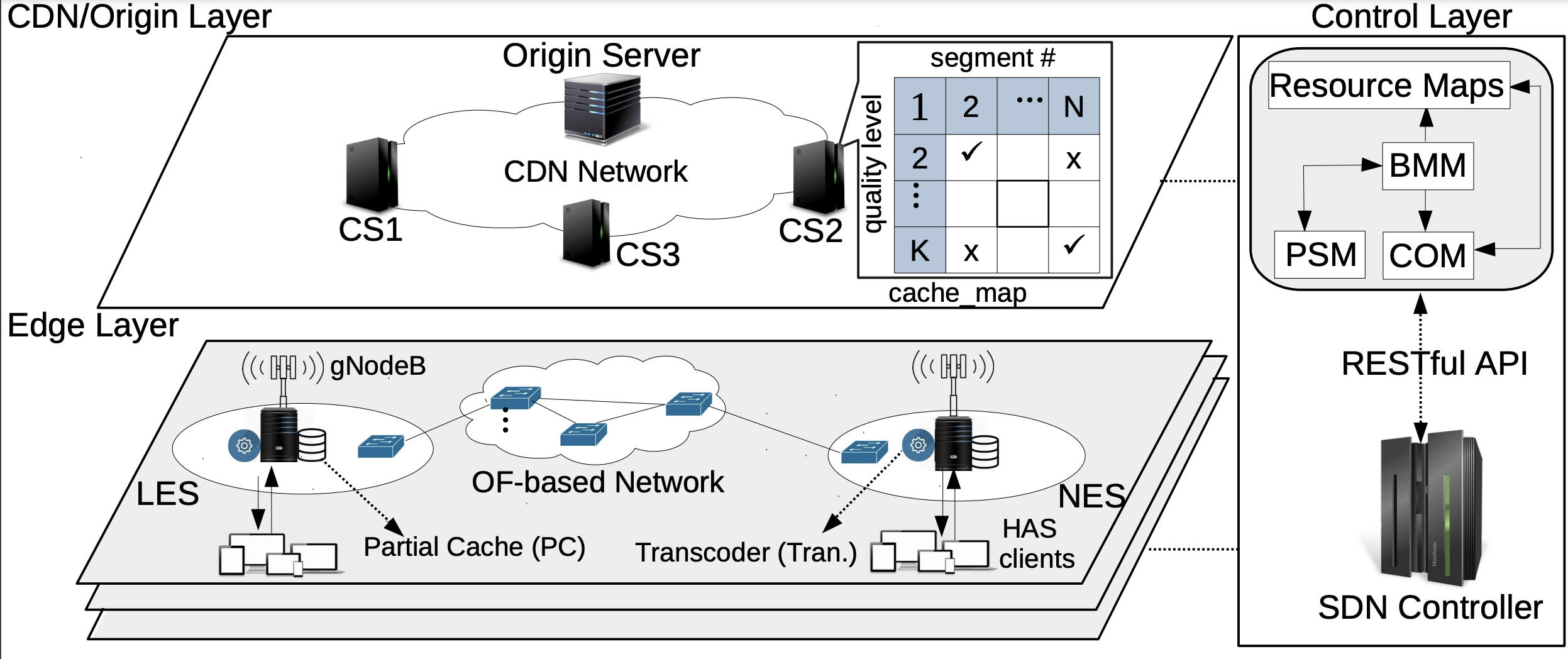
Abstract: With the ever-increasing demands for high-definition and low-latency video streaming applications, network-assisted video streaming schemes have become a promising complementary solution in the HTTP Adaptive Streaming (HAS) context to improve users’ Quality of Experience (QoE) as well as network utilization. Edge computing is considered one of the leading networking paradigms for designing such systems by providing video processing and caching close to the end-users. Despite the wide usage of this technology, designing network-assisted HAS architectures that support low-latency and high-quality video streaming, including edge collaboration is still a challenge. To address these issues, this article leverages the Software-Defined Networking (SDN), Network Function Virtualization (NFV), and edge computing paradigms to propose A collaboRative edge-Assisted framewoRk for HTTP Adaptive video sTreaming (ARARAT). Aiming at minimizing HAS clients’ serving time and network cost, besides considering available resources and all possible serving actions, we design a multi-layer architecture and formulate the problem as a centralized optimization model executed by the SDN controller. However, to cope with the high time complexity of the centralized model, we introduce three heuristic approaches that produce near-optimal solutions through efficient collaboration between the SDN controller and edge servers. Finally, we implement the ARARAT framework, conduct our experiments on a large-scale cloud-based testbed including 250 HAS players, and compare its effectiveness with state-of-the-art systems within comprehensive scenarios. The experimental results illustrate that the proposed ARARAT methods (i) improve users’ QoE by at least 47%, (ii) decrease the streaming cost, including bandwidth and computational costs, by at least 47%, and (iii) enhance network utilization, by at least 48% compared to state-of-the-art approaches.
Index Terms—HTTP Adaptive Streaming (HAS), Network-Assisted Video Streaming, Software-Defined Networking (SDN), Network Function Virtualization (NFV), Edge Computing, Edge Collaboration, Video Transcoding.
27th September 2022 | Rennes, France
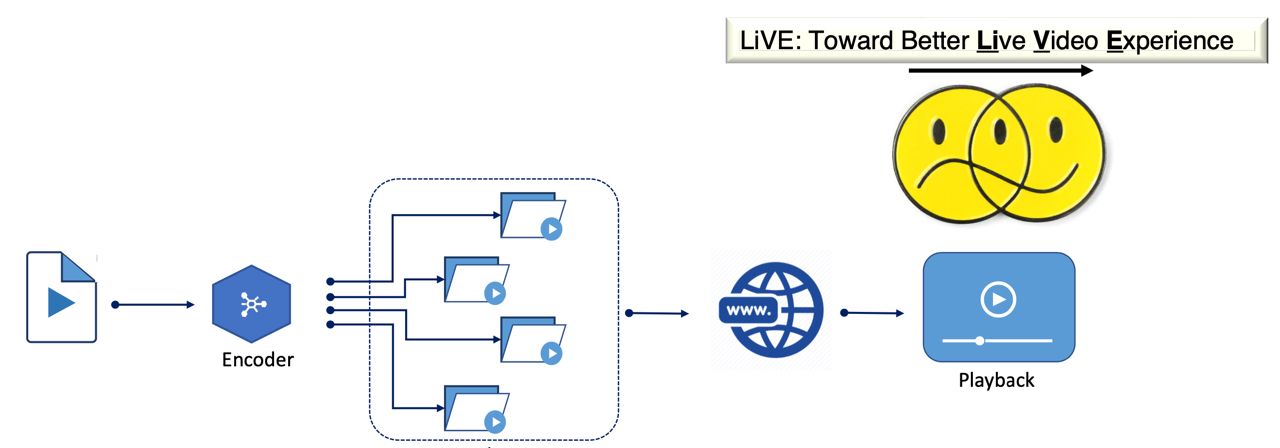
Abstract: In this presentation, we first introduce the principles of video streaming and the existing challenges. While live video streaming is expected to continue growing at an accelerated pace, one potential area for optimization that has remained relatively untapped is the use of content-aware encoding to improve the quality of live contribution streams due to avoid of latency. In this talk, we introduce revolutionary real-time content-aware video quality improvement methods for live applications that keep the added latency very low.
 Hadi Amirpour is a postdoctoral researcher at the University of Klagenfurt. He received his B.Sc. degrees in Electrical and Biomedical Engineering, and he pursued his M.Sc. in Electrical Engineering. He got his Ph.D. in computer science from the University of Klagenfurt in 2022. He was involved in the project EmergIMG, a Portuguese consortium on emerging imaging technologies, funded by the Portuguese funding agency and H2020. Currently, he is working on the ATHENA project in cooperation with its industry partner Bitmovin. His research interests are image processing and compression, video processing and compression, quality of assessment, emerging 3D imaging technology, and medical image analysis.
31 October – 4 November, 2022 | Thessaloniki, Greece
Minh Nguyen (AAU, Austria), Babak Taraghi (AAU, Austria), Abdelhak Bentaleb (National University of Singapore, Singapore), Roger Zimmermann (National University of Singapore, Singapore), and Christian Timmerer (AAU, Austria)
Abstract: Considering network conditions, video content, and viewer device type/screen resolution to construct a bitrate ladder is necessary to deliver the best Quality of Experience (QoE). A large-screen device like a TV needs a high bitrate with high resolution to provide good visual quality, whereas a small one like a phone requires a low bitrate with low resolution. In addition, encoding high-quality levels at the server side while the network is unable to deliver them causes unnecessary cost for the content provider. Recently, the Common Media Client Data (CMCD) standard has been proposed, which defines the data that is collected at the client and sent to the server with its HTTP requests. This data is useful in log analysis, quality of service/experience monitoring and delivery improvements.
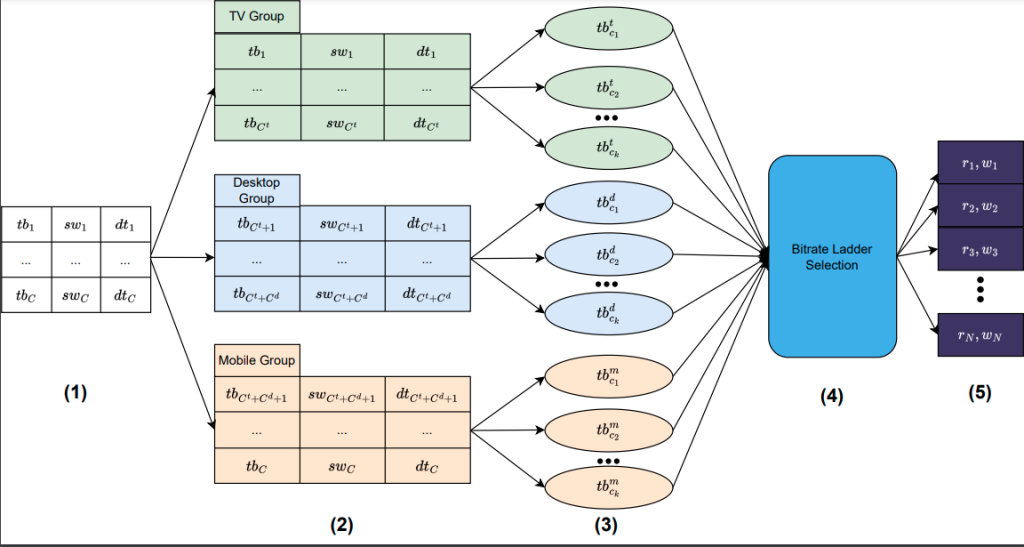
In this paper, we introduce a CMCD-Aware per-Device bitrate LADder construction (CADLAD) that leverages CMCD to address the above issues. CADLAD comprises components at both client and server sides. The client calculates the top bitrate (tb) — a CMCD parameter to indicate the highest bitrate that can be rendered at the client — and sends it to the server together with its device type and screen resolution. The server decides on a suitable bitrate ladder, whose maximum bitrate and resolution are based on CMCD parameters, to the client device with the purpose of providing maximum QoE while minimizing delivered data. CADLAD has two versions to work in Video on
Demand (VoD) and live streaming scenarios. Our CADLAD is client agnostic; hence, it can work with any players and ABR algorithms at the client. The experimental results show that CADLAD is able to increase the QoE by 2.6x while saving 71% of delivered data, compared to an existing bitrate ladder of an available video dataset. We implement our idea within CAdViSE — an open-source testbed for reproducibility.
ACM Multimedia Conference – Doctoral Symposium Track
Lisbon, Portugal | 10-14 October 2022
Vignesh V Menon (Christian Doppler Laboratory ATHENA, Alpen-Adria-Universität Klagenfurt)
Abstract: Rapid growth in multimedia streaming traffic over the Internet motivates the research and further investigation of the video coding performance of such services in terms of speed and Quality of Experience (QoE). HTTP Adaptive Streaming (HAS) is today’s de-facto standard to deliver clients the highest possible video quality. In HAS, the same video content is encoded at multiple bitrates, resolutions, framerates, and coding formats called representations. This study aims to (i) provide fast and compression-efficient multi-bitrate, multi-resolution representations, (ii) provide fast and compression-efficient multi-codec representations, (iii) improve the encoding efficiency of Video on Demand (VoD) streaming using content-adaptive encoding optimizations, and (iv) provide encoding schemes with optimizations per-title for live streaming applications to decrease the storage or delivery costs or/and increase QoE.
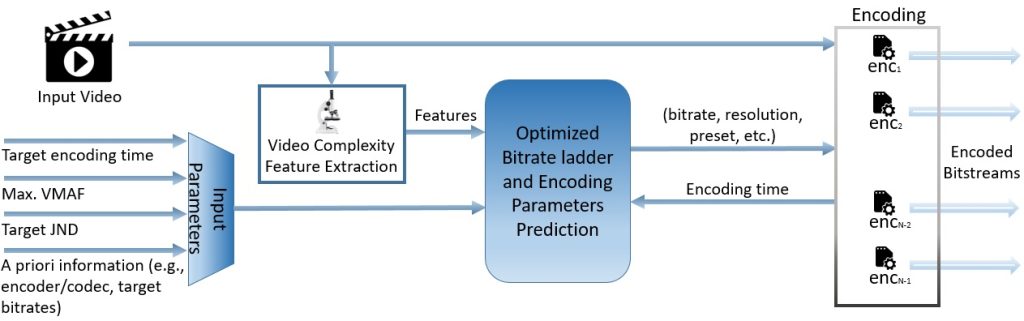
The ideal video compression system for HAS envisioned in this doctoral study.
The Institute of Information Technology at the
Alpen-Adria-Universität Klagenfurt
invites applications for:
Doctoral Student Positions (100% employment; all genders welcome)
within the Christian Doppler (CD) Pilot Laboratory ATHENA
“Adaptive Streaming over HTTP and
Emerging Networked Multimedia Services”
The expected start date of employment is April 1st, 2023.
Application deadline: December 1st, 2022.
Find the complete job description here.
Come and join our ATHENA team!











 Multimedia Communication ITEC Homepage