Every minute, more than 500 hours of video material are published on YouTube. These days, moving images account for a vast majority of data traffic, and there is no end in sight. This means that technologies that can improve the efficiency of video streaming are becoming all the more important. This is exactly what Hadi Amirpourazarian is working on in the Christian Doppler Laboratory ATHENA at the University of Klagenfurt. Read the full article here.
Posted inATHENA|Comments Off on Fast and smooth video experience
As Valentine’s day gift to video coding enthusiasts across the globe, we released Video Complexity Analyzer (VCA) version 1.0 open-source software on Feb 14, 2022. The primary objective of VCA is to become the best spatial and temporal complexity predictor for every frame/ video segment/ video which aids in predicting encoding parameters for applications like scene-cut detection and online per-title encoding. VCA leverages x86 SIMD and multi-threading optimizations for effective performance. While VCA is primarily designed as a video complexity analyzer library, a command-line executable is provided to facilitate testing and development. We expect VCA to be utilized in many leading video encoding solutions in the coming years.
VCA is available as an open-source library, published under the GPLv3 license. For more details, please visit the software online documentation here. The source code can be found here.
Heatmap of spatial complexity (E)
Heatmap of temporal complexity (h)
A performance comparison (frames analyzed per second) of VCA (with different levels of threading enabled) compared to Spatial Information/Temporal Information (SITI) [Github] is shown below:
Further information about a few possible VCA applications can be found at:
Vignesh V Menon (Alpen-Adria-Universität Klagenfurt), Hadi Amirpour (Alpen-Adria-Universität Klagenfurt), Christian Feldmann (Bitmovin, Klagenfurt),
Adithyan Ilangovan (Bitmovin, Klagenfurt), Martin Smole (Bitmovin, Klagenfurt), Mohammad Ghanbari (School of Computer Science and Electronic Engineering, University of Essex, Colchester, UK), and Christian Timmerer (Alpen-Adria-Universität Klagenfurt).
Abstract:
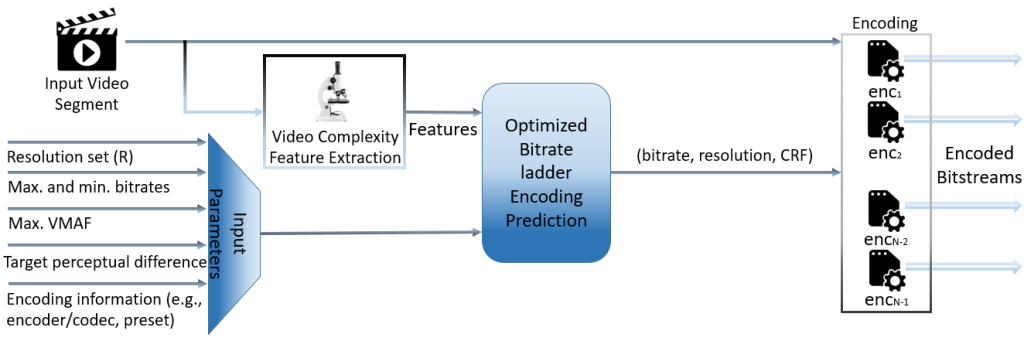
Current per-title encoding schemes encode the same video content at various bitrates and spatial resolutions to find optimal bitrate-resolution pairs (known as bitrate ladder) for each video content in Video on Demand (VoD) applications. But in live streaming applications, a fixed bitrate ladder is used for simplicity and efficiency to avoid the additional latency to find the optimized bitrate-resolution pairs for every video content. However, an optimized bitrate ladder may result in (i) decreased storage or network resources or/and (ii) increased Quality of Experience (QoE). In this paper, a fast and efficient per-title encoding scheme (Live-PSTR) is proposed tailor-made for live Ultra High Definition (UHD) High Framerate (HFR) streaming. It includes a pre-processing step in which Discrete Cosine Transform (DCT)-energy-based low-complexity spatial and temporal features are used to determine the complexity of each video segment, based on which the optimized encoding resolution and framerate for streaming at every target bitrate is determined. Experimental results show that, on average, Live-PSTR yields bitrate savings of 9.46% and 11.99% to maintain the same PSNR and VMAF scores, respectively compared to the HTTP Live Streaming (HLS) bitrate ladder.
The Emmy® Awards do not only honour the work of actors and directors but also recognize technologies that are steadily improving the viewing experience for consumers.
This year, the winners include the MPEG DASH Standard. Christian Timmerer (Department of Information Technology) played a leading role in its development.
Minh Nguyen (AAU, Austria), Christian Timmerer (AAU, Austria), Stefan Pham (Fraunhofer FOKUS, Germany), Daniel Silhavy (Fraunhofer FOKUS, Germany), Ali C. Begen (Ozyegin University, Turkey)
Abstract: With theintroductionofHTTP/3(H3)andQUICatitscore, there is an expectation of significant improvements in Web-based secureobject delivery.AsHTTPisacentralprotocoltothe current adaptive streaming methods in all major over-the-top (OTT) services, an important question is what H3 will bring to the table for such services. To answer this question, we present the new features of H3 and QUIC, and compare them to those of H/1.1/2 and TCP. We also share the latest research findings in this domain.
Keywords: HTTP adaptive streaming, QUIC, CDN, ABR, OTT, DASH, HLS.
Minh Nguyen (AAU, Austria), Ekrem Çetinkaya (AAU, Austria), Hermann Hellwagner (AAU, Austria), and Christian Timmerer (AAU, Austria)
Abstract: The advancement of mobile hardware in recent years made it possible to apply deep neural network (DNN) based approaches on mobile devices. This paper introduces a lightweight super-resolution (SR) network, namely SR-ABR Net, deployed at mobile devices to upgrade low-resolution/low-quality videos and a novel adaptive bitrate (ABR) algorithm, namely WISH-SR, that leverages SR networks at the client to improve the video quality depending on the client’s context. WISH-SR takes into account mobile device properties, video characteristics, and user preferences. Experimental results show that the proposed SR-ABR Net can improve the video quality compared to traditional SR approaches while running in real-time. Moreover, the proposed WISH-SR can significantly boost the visual quality of the delivered content while reducing both bandwidth consumption and the number of stalling events.
Keywords: Super-resolution, Deep Neural Networks, Mobile Devices, ABR
On Tuesday the 25th of January 2022, Hadi Amirpour successfully defended his Ph.D. thesis under supervision of Assoc.-Prof. DI Dr. Christian Timmerer and Assoc.-Prof. Dr. Klaus Schöffmann. The defense was chaired by Assoc.-Prof. DI Dr. Mathias Lux and the examiners were Emeritus Prof. Dr. Mohammad Ghanbari (University of Essex, UK) and Univ.-Prof. DI Dr. Hermann Hellwagner (University of Klagenfurt).
We are pleased to congratulate Dr. Hadi Amirpour on passing his Ph.D. exam!
Posted inATHENA|Comments Off on Hadi Amirpour has successfully defended his PhD thesis