AGSR: Aperture-Guided Super-Resolution for Gaussian Splatting
Ayman Alkhateeb, Hadi Amirpour, Christian Timmerer
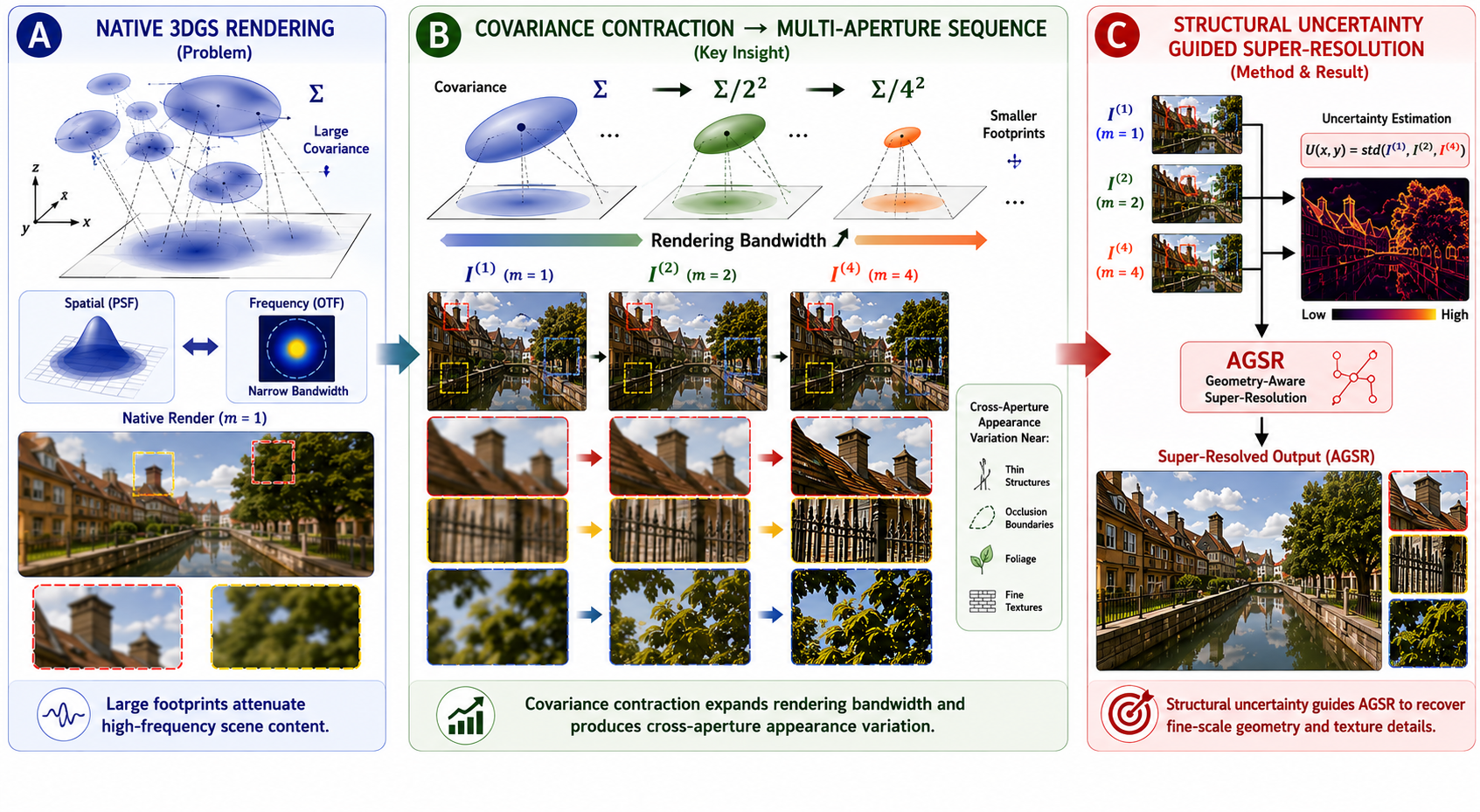
3D Gaussian Splatting (3DGS) enables real-time novel view synthesis, but Gaussian rasterization attenuates fine-scale scene structure through the projected covariance of each primitive. We show that contracting projected covariances at inference time reveals recoverable structural cues that remain latent in the learned representation, motivating a multi-aperture rendering framework for super-resolution.
Based on this insight, we propose AGSR (Aperture-Guided Super-Resolution), a lightweight inference-time framework that progressively fuses multi-aperture renderings using uncertainty-guided feature aggregation and geometric conditioning from transmittance and depth cues. AGSR operates as a plug-in enhancement for pre-trained 3DGS models.
Experiments on the Mip-NeRF 360 benchmark show that AGSR outperforms lightweight image-space super-resolution baselines, with gains increasing as the underlying Gaussian representation deteriorates. The results provide empirical evidence that covariance contraction exposes recoverable structural cues attenuated by native Gaussian rasterization. AGSR achieves these improvements while maintaining real-time performance with up to 66K parameters.