Wave-Aware Primitive Culling for Scalable Gaussian Wave Splatting
Ayman Alkhateeb, Hadi Amirpour, Christian Timmerer
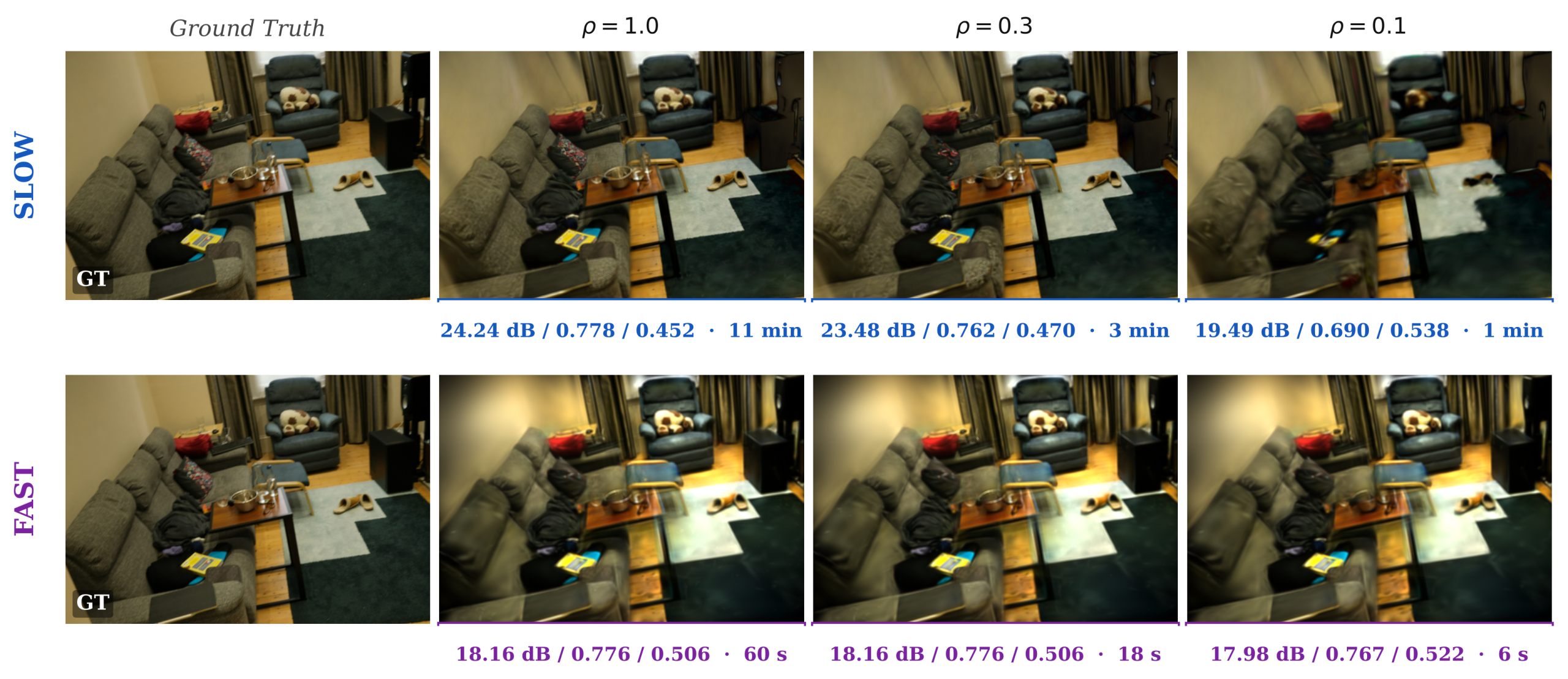
Computer-generated holography (CGH) enables realistic depth perception by reconstructing full optical wavefields, but its practical use is limited by high computational cost. Gaussian Wave Splatting (GWS) represents a promising direction by mapping Gaussian scene primitives directly into complex wavefields, but even its accelerated formulations remain computationally expensive due to the high processing time required for large numbers of primitives. In this work, we present a novel, energy-based culling criterion derived from the angular spectrum formulation of wave propagation to remove redundant primitives in Gaussian Wave Splatting (GWS). Our energy criterion, based on opacity and spatial scale, provides a physics-inspired way to estimate each primitive’s contribution and enables multi-resolution rendering without retraining. Evaluations on the Mip-NeRF 360 dataset show that our criterion effectively isolates the scene’s structural backbone. By discarding up to 70 % of primitives, our method accelerates rendering by 72% in fast additive pipelines with near-lossless reconstruction quality (Delta PSNR <= 0.05 dB compared to the unculled baseline). Furthermore, it achieves a 70% speedup in exact alpha-wave-blending pipelines while preserving high perceptual fidelity, providing a critical step toward real-time neural rendering for holographic displays.