Selective Multi-Pass Encoding for Cost-Efficient Video Streaming
International Broadcasting Convention (IBC)
[PDF]
Mohammad Ghasempour (AAU, Austria), Hadi Amirpour (AAU, Austria), and Christian Timmerer (AAU, Austria)
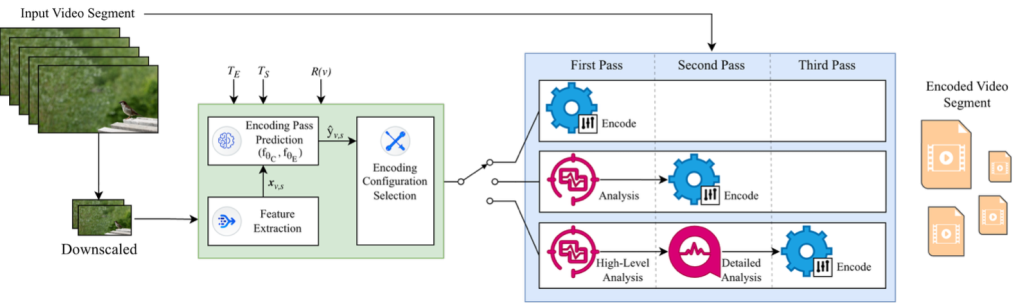
Abstract: As video streaming scales across platforms, resolutions, and devices, encoding efficiency has become critical to maintaining quality while controlling computational cost and energy consumption. Multi-pass encoding is widely used in streaming workflows to improve compression efficiency, rate-control accuracy, and quality consistency. However, its computational overhead is applied uniformly across all content, even when additional passes deliver minimal benefit. At scale, this results in unnecessary processing, higher computational cost, and increased energy consumption. This paper presents a content-adaptive strategy, CASE, that predicts whether additional encoding passes would provide meaningful gains using a lightweight mechanism that derives spatial and temporal features from each video segment. We evaluated the approach in two production-oriented scenarios using local and cloud-based video encoders. Results show that the method reduces computational time and encoding cost, with minimal impact on compression efficiency and visual quality. Experimental results show that CASE reduces encoding time by 25.3% on average with only a 2.23% bitrate increase, while its preprocessing and decision overhead is about 1155 times lower than multi-pass encoding time.