Vignesh V Menon is invited to talk on “Video Coding for HTTP Adaptive Streaming” on the Research@Lunch, which is a research webinar series by Humanitarian Technology (HuT) Labs, Amrita Vishwa Vidyapeetham University, India, exclusively for Ph.D. Scholars, UG, and PG Researchers in India. This talk will introduce the basics of video codecs and highlight the scope of HAS-related research on video encoding.
Time: August 14, 10.00AM-10.30AM (CEST) or 1.30PM- 2.00PM (IST)
Abstract: Video streaming has become one of the most prevailing, bandwidth-hungry, and latency-sensitive Internet applications. HTTP Adaptive Streaming (HAS) has become the dominant video delivery mechanism over the Internet. Lack of coordination among the clients and lack of awareness of the network in pure client-based adaptive video bitrate approaches have caused problems, such as sub-optimal data throughput from Content Delivery Network (CDN) or origin servers, high CDN costs, and non-satisfactory users’ experience. Recent studies have shown that network-assisted HAS techniques by utilizing modern networking paradigms, e.g., Software-Defined Networking (SDN), Network Function Virtualization (NFV), and edge computing can significantly improve HAS system performance. In this doctoral study, we leverage the aforementioned modern networking paradigms and design network assistance for/by HAS clients to improve HAS systems performance and CDN/network utilization. We present four fundamental research questions to target different challenges in devising a network-assisted HAS system.
Machine Learning Based Video Coding Enhancements for HTTP Adaptive Streaming
Abstract: Video traffic comprises the majority of today’s Internet traffic, and HTTP Adaptive Streaming (HAS) is the preferred method to deliver video content over the Internet. Increasing demand for video and the improvements in the video display conditions over the years caused an increase in the video coding complexity. This increased complexity brought the need for more efficient video streaming and coding solutions. The latest standard video codecs can reduce the size of the videos by using more efficient tools with higher time-complexities. The plans for integrating machine learning into upcoming video codecs raised the interest in applied machine learning for video coding. In this doctoral study, we aim to propose applied machine learning methods to video coding, focusing on HTTP adaptive streaming. We present four primary research questions to target different challenges in video coding for HTTP adaptive streaming.
Abstract: Video streaming is the most used service in mobile networks and its usage will continue growing in the upcoming years. Due to this increase, content delivery should be improved as a key aspect of video streaming service, supporting higher bandwidth demand while assuring high quality of experience (QoE) for all the users. Multi-access edge computing (MEC) is an emerging paradigm that brings computational power and storage closer to the user. It is seen in the industry as a key technology for 5G mobile networks, with the goals of reducing latency, ensuring highly efficient network operation, improving service delivery and offering an improved user experience, among others. In this doctoral study, we aim to leverage the possibilities of MEC to improve the content delivery of video streaming services. We present four main research questions to target the different challenges in content delivery for HTTP Adaptive Streaming.
Optimizing QoE and Latency of Live Video Streaming Using Edge Computing and In-Network Intelligence
Abstract: Live video streaming traffic and related applications have experienced significant growth in recent years. More users have started generating and delivering live streams with high quality (e.g., 4K resolution) through popular online streaming platforms such as YouTube, Twitch, and Facebook. Typically, the video contents are generated by streamers and watched by many audiences, which are geographically distributed in various locations far away from the streamers’ locations. The resource limitation in the network (e.g., bandwidth) is a challenging issue for network and video providers to meet the users’ requested quality. In this thesis, we will investigate optimizing QoE and end-to-end (E2E) latency of live video streaming by leveraging edge computing capabilities and in-network intelligence. We present four main research questions aiming to address the various challenges in optimizing live streaming QoE and E2E latency by employing edge computing and in-network intelligence.
Policy-driven Dynamic HTTP Adaptive Streaming Player Environment
Abstract: Video streaming services account for the majority of today’s traffic on the Internet. Although the data transmission rate has been increasing significantly, the growing number and variety of media and higher quality expectations of users have led networked media applications to fully or even over-utilize the available throughput. HTTP Adaptive Streaming (HAS) has become a predominant technique for multimedia delivery over the Internet today. However, there are critical challenges for multimedia systems, especially the tradeoff between the increasing content (complexity) and various requirements regarding time (latency) and quality (QoE). This thesis will cover the main aspects within the end user’s environment, including video consumption and interactivity, collectively referred to as player environment, which is probably the most crucial component in today’s multimedia applications and services. We will investigate the methods that can enable the specification of various policies reflecting the user’s needs in given use cases. Besides, we will also work on schemes that allow efficient support for server-assisted, and network-assisted HAS systems. Finally, those approaches will be considered to combine into policies that fit the requirements of all use cases (e.g., live streaming, video on demand, etc.).
Posted inATHENA|Comments Off on ATHENA Papers Accepted at ACM MMSys’21 Doctoral Symposium
Abstract: Due to the growing demand for video streaming services, providers have to deal with increasing resource requirements for increasingly heterogeneous environments. To mitigate this problem, many works have been proposed which aim to (i) improve cloud/edge caching efficiency, (ii) use computation power available in the cloud/edge for on-the-fly transcoding, and (iii) optimize the trade-off among various cost parameters,e.g., storage, computation, and bandwidth. In this paper, we propose LwTE, a novel light-weight transcoding approach at the edge, in the context of HTTP Adaptive Streaming (HAS). During the encoding process of a video segment at the origin side, computationally intense search processes are going on. The main idea ofLwTEis to store the optimal results of these search processes as metadata for each video bitrate and reuse them at the edge servers to reduce the required time and computational resources for on-the-fly transcoding.LwTEenables us to store only the highest bitrate plus corresponding metadata (of very small size) for unpopular video segments/bitrates. In this way, in addition to the significant reduction in bandwidth and storage consumption, the required time for on-the-fly transcoding of a requested segment is remarkably decreased by utilizing its corresponding metadata; unnecessary search processes are avoided. Popular video segments/bitrates are being stored. We investigate our approach for Video-on-Demand (VoD)streaming services by optimizing storage and computation (transcoding) costs at the edge servers and then compare it to conventional methods (store all bitrates, partial transcoding). The results indicate that our approach reduces the transcoding time by at least 80% and decreases the aforementioned costs by 12% to70% compared to the state-of-the-art approaches.
Keywords: Video streaming, transcoding, video on demand, edge computing.
Posted inATHENA|Comments Off on LwTE: Light-weight Transcoding at the Edge
Minh Nguyen (AAU, Austria), Ekrem Çetinkaya (AAU, Austria), Hermann Hellwagner (AAU, Austria), and Christian Timmerer (AAU, Austria)
Abstract: Recently, mobile devices have become paramount in online video streaming. Adaptive bitrate (ABR) algorithms of players responsible for selecting the quality of the videos face critical challenges in providing a high Quality of Experience (QoE) for end users. One open issue is how to ensure the optimal experience for heterogeneous devices in the context of extreme variation of mobile broadband networks. Additionally, end users may have different priorities on video quality and data usage (i.e., the amount of data downloaded to the devices through the mobile networks). A generic mechanism for players that enables specification of various policies to meet end users’ needs is still missing. In this paper, we propose a weighted sum model, namely WISH, that yields high QoE of the video and allows end users to express their preferences among different parameters (i.e., data usage, stall events, and video quality) of video streaming. WISH has been implemented into ExoPlayer, a popular player used in many mobile applications. The experimental results show that WISH improves the QoE by up to 17.6% while saving 36.4% of data usage compared to state-of-the-art ABR algorithms and provides dynamic adaptation to end users’ requirements.
Keywords: ABR Algorithms, HTTP Adaptive Streaming, ITU-T P.1203, WISH
Vignesh V Menon (Alpen-Adria-Universitat Klagenfurt); Hadi Amirpour (Alpen-Adria-Universität Klagenfurt); Christian Timmerer (Alpen-Adria-Universität Klagenfurt, Austria); Mohammad Ghanbari (University of Essex, UK).
Abstract:
High Efficiency Video Coding (HEVC) improves the encoding efficiency by utilizing sophisticated tools such as flexible Coding Tree Unit (CTU) partitioning. The Coding Unit (CU) can be split recursively into four equally sized CUs ranging from 64×64 to 8×8 pixels. At each depth level (or CU size), intra prediction via exhaustive mode search was exploited in HEVC to improve the encoding efficiency and result in a very high encoding time complexity. This paper proposes an Intra CU Depth Prediction (INCEPT) algorithm, which limits Rate-Distortion Optimization (RDO) for each CTU in HEVC by utilizing the spatial correlation with the neighboring CTUs, which is computed using a DCT energy-based feature. Thus, INCEPT reduces the number of candidate CU sizes required to be considered for each CTU in HEVC intra coding. Experimental results show that the INCEPT algorithm achieves a better trade-off between the encoding efficiency and encoding time saving (i.e., BDR/∆T) than the benchmark algorithms. While BDR/∆T is 12.35% and 9.03% for the benchmark algorithms, it is 5.49% for the proposed algorithm. As a result, INCEPT achieves a 23.34% reduction in encoding time on average while incurring only a 1.67% increase in bit rate than the original coding in the x265 HEVC open-source encoder.
Keywords:HEVC, Intra coding, CTU, CU, depth decision
ViSNext’21: 1st ACM CoNEXT Workshop on Design, Deployment, and Evaluation of Network-assisted Video Streaming
In recent years, we have witnessed phenomenal growth in live video traffic over the Internet, accelerated by the rise of novel video streaming technologies, advancements in networking paradigms, and our ability to generate, process, and display videos on heterogeneous devices. Regarding the existing constraints and limitations in different components on the video delivery path from the origin server to clients, the network plays an essential role in boosting the perceived Quality of Experience (QoE) by clients. The ViSNext workshop aims to bring together researchers and developers working on all aspects of video streaming, in particular network-assisted concepts backed up by experimental evidence. We warmly invite submission of original, previously unpublished papers addressing key issues in this area, but not limited to:
Design, analysis, and evaluation of network-assisted multimedia system architectures
Optimization of edge, fog, and mobile edge computing for video streaming applications
Optimization of caching policies/systems for video streaming applications
Network-assisted resource allocation for video streaming
Experience and lessons learned by deploying large-scale network-assisted video streaming
Internet measurement and modeling for enhancing QoE in video streaming applications
Design, analysis, and evaluation of network-assisted Adaptive Bitrate (ABR) streaming
Network aspects in video streaming: cloud computing, virtualization techniques, network control, and management, including SDN, NFV, and network programmability
Routing and traffic engineering in end-to-end video streaming
Topics at the intersection of energy-efficient computing and networking for video streaming
Network-assisted techniques for low-latency video streaming
Machine learning for improving QoE in video streaming applications
Machine learning for traffic engineering and congestion control for video streaming
Solutions for improving streaming QoE for high-speed user mobility
Analysis, modeling, and experimentation of DASH
Big data analytics at the network edge to assess viewer experience of adaptive video
Reproducible research in adaptive video streaming: datasets, evaluation methods, benchmarking, standardization efforts, open-source tools
Novel use cases and applications in the area of adaptive video streaming
Advanced network-based techniques for point clouds, light field, and immersive video
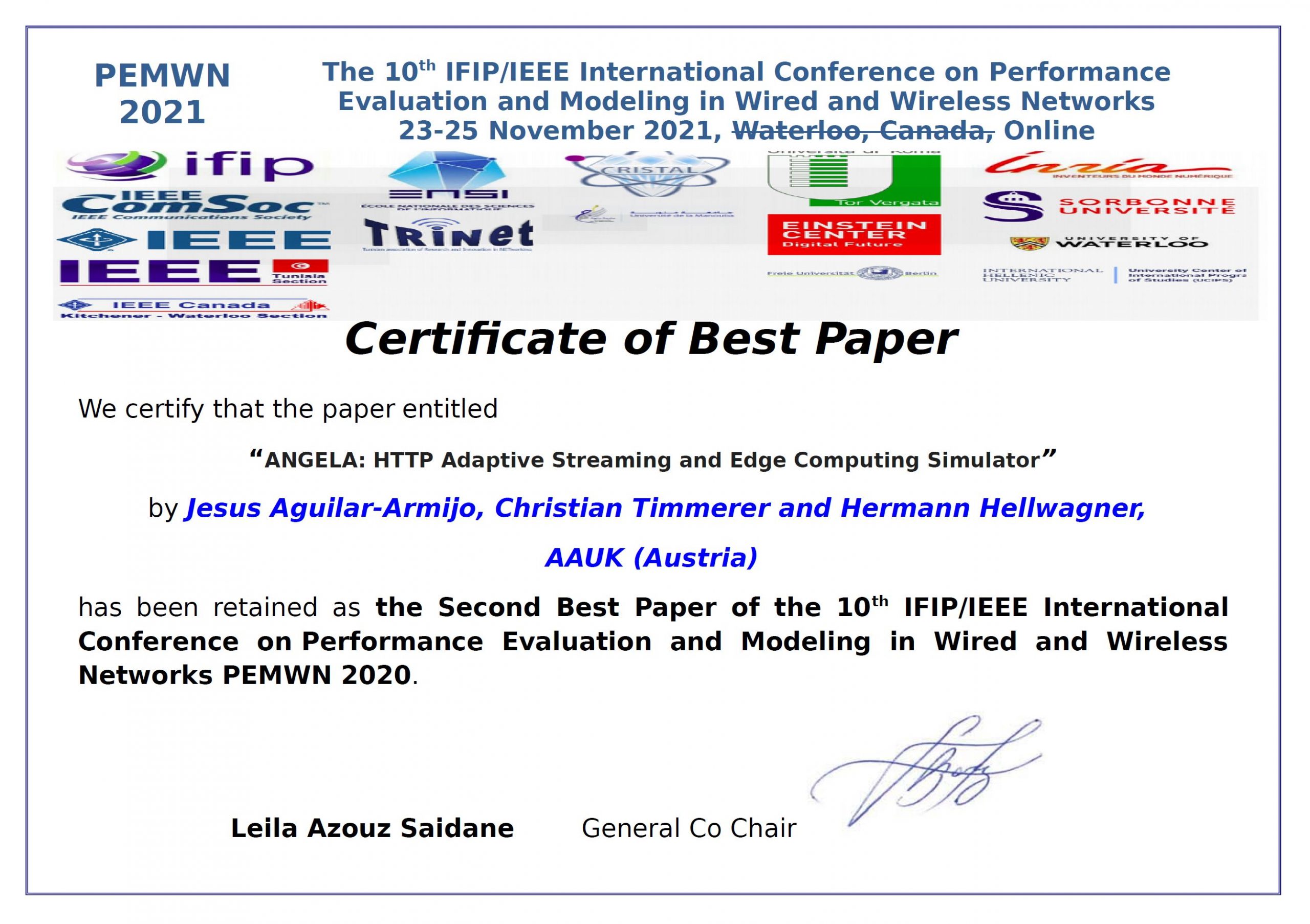
Jesús Aguilar Armijo(Alpen-Adria-Universität Klagenfurt), Christian Timmerer (Alpen-Adria-Universität Klagenfurt) and Hermann Hellwagner (Alpen-Adria-Universität Klagenfurt)
Abstract: Mobile networks equipped with edge computing nodes enable access to information that can be leveraged to assist client-based adaptive bitrate (ABR) algorithms in making better adaptation decisions to improve both Quality of Experience (QoE) and fairness. For this purpose, we propose a novel on-the-fly edge mechanism, named EADAS (Edge Assisted Adaptation Scheme for HTTP Adaptive Streaming), located at the edge node that assists and improves the ABR decisions on-the-fly. EADAS proposes (i) an edge ABR algorithm to improve QoE and fairness for clients and (ii) a segment prefetching scheme. The results show a QoE increase of 4.6%, 23.5%, and 24.4% and a fairness increase of 11%, 3.4%, and 5.8% when using a buffer-based, a throughput-based, and a hybrid ABR algorithm, respectively, at the client compared with client-based algorithms without EADAS. Moreover, QoE and fairness among clients can be prioritized using parameters of the EADAS algorithm according to service providers’ requirements.
Keywords: Dynamic Adaptive Streaming over HTTP (DASH), Edge Computing, Network-Assisted Video Streaming, Quality of Experience (QoE).