ANGELA won the 2nd Best Paper Award in IFIP/IEEE PEMWN 2021 Conference

The ANGELA: HTTP Adaptive Streaming and Edge Computing Simulator paper from ATHENA lab has won the 2nd Best Paper Award in the 10th IFIP/IEEE International Conference on Performance Evaluation and Modeling in Wired and Wireless Networks (PEMWN).

More information about the paper can be found in the blog post.


Posted in ATHENA | Comments Off on ANGELA won the 2nd Best Paper Award in IFIP/IEEE PEMWN 2021 Conference

Farzad Tashtarian to give a talk at IMDEA Networks Institute, Madrid, Spain

Farzad Tashtarian is invited to talk on “LwTE: Light-weight Transcoding at the Edge” at IMDEA Networks Institute, Madrid, Spain. [Slides]

https://www.slideshare.net/christian.timmerer/lwte-lightweight-transcoding-at-the-edge

Posted in ATHENA | Comments Off on Farzad Tashtarian to give a talk at IMDEA Networks Institute, Madrid, Spain

Internship 2022 at ATHENA

At Christian Doppler laboratory ATHENA, we offer an internship*) for 2022 for Master Students and we kindly request your applications until 14th of December 2021 with the following data (in German or English):

  • CV
  • Record of study/transcript (“Studienerfolgsnachweis”)

*) A 3-month period in 2022 (with an exact time slot to be discussed) with the possibility to spend up to 1-month at the industrial partner; 20h per week “Universitäts-KV, Verwendungsgruppe C1, studentische Hilfskraft”

Please send your application by email to nina.stiller@aau.at.


About ATHENA: The Christian Doppler laboratory ATHENA (AdapTive Streaming over HTTP and Emerging Networked MultimediA Services) is jointly proposed by the Institute of Information Technology (ITEC; http://itec.aau.at) at Alpen-Adria-Universität Klagenfurt (AAU) and Bitmovin GmbH (https://bitmovin.com) to address current and future research and deployment challenges of HAS and emerging streaming methods. AAU (ITEC) has been working on adaptive video streaming for more than a decade, has a proven record of successful research projects and publications in the field, and has been actively contributing to MPEG standardization for many years, including MPEG-DASH; Bitmovin is a video streaming software company founded by ITEC researchers in 2013 and has developed highly successful, global R&D and sales activities and a world-wide customer base since then.

The aim of ATHENA is to research and develop novel paradigms, approaches, (prototype) tools, and evaluation results for the phases

  1. multimedia content provisioning,
  2. content delivery, and
  3. content consumption in the media delivery chain as well as for
  4. end-to-end aspects, with a focus on, but not being limited to, HTTP Adaptive Streaming (HAS).

The new approaches and insights are to enable Bitmovin to build innovative applications and services to account for the steadily increasing and changing multimedia traffic on the Internet.

Posted in ATHENA | Comments Off on Internship 2022 at ATHENA

Paper in CMC-Computers, Materials & Continua Journal accepted

Title: FSpot: Fast Multi-Objective Heuristic for Efficient Video Encoding Workloads over AWS EC2 Spot Instance Fleet [PDF] *** open access ***

Authors: Anatoliy Zabrovskiy, Prateek Agrawal, Vladislav Kashansky, Roland Kersche, Christian Timmerer, and Radu Prodan

Abstract: HTTP Adaptive Streaming (HAS) of video content is becoming an undivided part of the Internet and accounts for most of today’s network traffic. Video compression technology plays a vital role in efficiently utilizing network channels, but encoding videos into multiple representations with selected encoding parameters is a significant challenge. However, video encoding is a computationally intensive and time-consuming operation that requires high-performance resources provided by on-premise infrastructures or public clouds. In turn, the public clouds, such as Amazon elastic compute cloud (EC2), provide hundreds of computing instances optimized for different purposes and clients’ budgets. Thus, there is a need for algorithms and methods for optimized computing instance selection for specific tasks such as video encoding and transcoding operations. Additionally, the encoding speed directly depends on the selected encoding parameters and the complexity characteristics of video content. In this paper, we first benchmarked the video encoding performance of Amazon EC2 spot instances using multiple x264 codec encoding parameters and video sequences of varying complexity. Then, we proposed a novel fast approach to optimize Amazon EC2 spot instances and minimize video encoding costs. Furthermore, we evaluated how the optimized selection of EC2 spot instances can affect the encoding cost. The results show that our approach, on average, can reduce the encoding costs by at least 15.8% and up to 47.8% when compared to a random selection of EC2 spot instances.

Keywords: EC2 Spot instance, Encoding time prediction; adaptive streaming; video transcoding; Clustering; HTTP adaptive streaming; MPEG-DASH; Cloud computing; optimization; Pareto front.

Posted in APOLLO, ATHENA | Comments Off on Paper in CMC-Computers, Materials & Continua Journal accepted

FaRes-ML Won the Best New Streaming Innovation Award in the Streaming Media Readers’ Choice Awards 2021

The Fast Multi-Resolution and Multi-Rate Encoding for HTTP Adaptive Streaming Using Machine Learning paper from ATHENA lab has won the Best New Streaming Innovation Award in the Streaming Media Readers’ Choice Awards 2021.

The journey that led to the publication of the FaRes-ML paper was quite an insightful one.

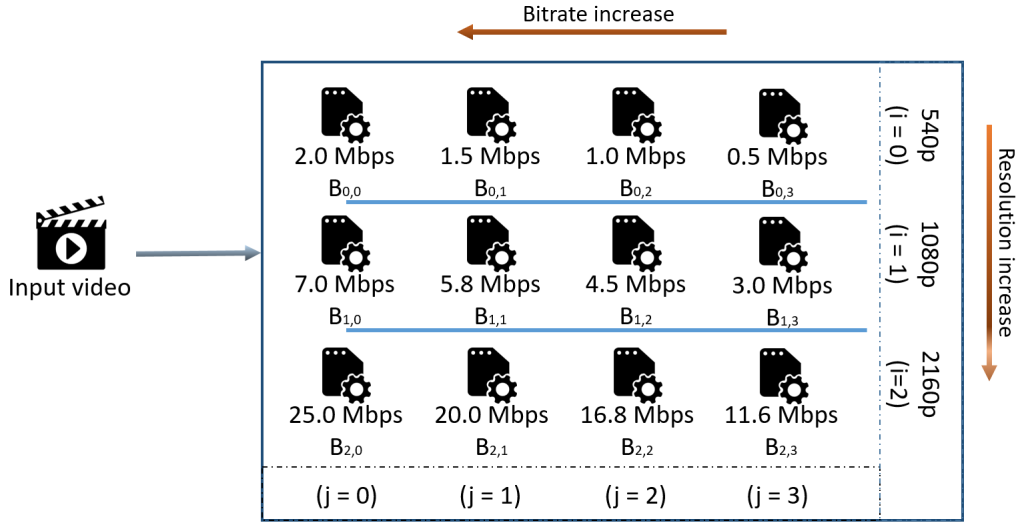
It all started with the question, “How to efficiently provide multi-rate representations over a wide range of resolutions for HTTP Adaptive Streaming?“. This led to the first publication, Fast Multi-Rate Encoding for Adaptive HTTP Streaming, in which we proposed a double-bound approach to speed up the multi-rate encoding. After analyzing the results, we saw room for improvement in parallel encoding performance, which led to the second publication Towards Optimal Multirate Encoding for HTTP Adaptive Streaming. The results were promising, but we believed we could improve the encoding performance by utilizing machine learning. That was the primary motivation behind our third paper, FaME-ML: Fast Multirate Encoding for HTTP Adaptive Streaming Using Machine Learning. In FaMe-ML, we have used convolutional neural networks (CNNs) to use the information from the reference representation better to encode other representations, resulting in significant improvement in the multi-rate encoding performance. Finally, we proposed FaRes-ML to extend our FaME-ML approach to include multi-resolution scenarios in Fast Multi-Resolution and Multi-Rate Encoding for HTTP Adaptive Streaming Using Machine Learning paper.

Here is the list of publications that led to FaRes-ML:

  1. Fast Multi-Rate Encoding for Adaptive HTTP Streaming. Published in DCC’20.
  2. Towards Optimal Multirate Encoding for HTTP Adaptive Streaming. Published in MMM’21.
  3. FaME-ML: Fast Multirate Encoding for HTTP Adaptive Streaming Using Machine Learning. Published in VCIP’20.
  4. Fast Multi-Resolution and Multi-Rate Encoding for HTTP Adaptive Streaming Using Machine Learning. Published in IEEE OJ-SP.
Posted in ATHENA | Comments Off on FaRes-ML Won the Best New Streaming Innovation Award in the Streaming Media Readers’ Choice Awards 2021

Christian Timmerer and Babak Taraghi will give talks at DDRC’21

Taichung, Taiwan, The 1st IEEE International Workshop on Data-Driven Rate Control for Media Streaming (DDRC’21) Co-located with the IEEE International Conference on Multimedia Big Data (BigMM’21)

Conference Website: https://www.bigmm.org/ (November 15-17)

HTTP Adaptive Streaming (HAS) — Quo Vadis?
Speaker: Professor Christian Timmerer
Time: November 16, 2021 12:10 (UTC +1)

https://www.slideshare.net/christian.timmerer/http-adaptive-streaming-quo-vadis

CAdViSE or how to find the Sweet Spots of ABR Systems
Speaker: Babak Taraghi, M.Sc.
Time: November 16, 2021 13:00 (UTC +1)

https://www.slideshare.net/christian.timmerer/cadvise-or-how-to-find-the-sweet-spots-of-abr-systems

Online attendance is free, Visit here for more information.

Posted in ATHENA | Comments Off on Christian Timmerer and Babak Taraghi will give talks at DDRC’21

ECAS-ML: Edge Computing Assisted Adaptation Scheme with Machine Learning for HTTP Adaptive Streaming

28th International Conference on Multimedia Modeling (MMM)

April 05-08, 2022 | Phu Quoc, Vietnam

Conference Website

[PDF][Poster]

Jesús Aguilar Armijo (Alpen-Adria-Universität Klagenfurt), Ekrem Çetinkaya (Christian Doppler Laboratory ATHENA, Alpen-Adria-Universität Klagenfurt), Christian Timmerer (Alpen-Adria-Universität Klagenfurt) and Hermann Hellwagner (Alpen-Adria-Universität Klagenfurt)

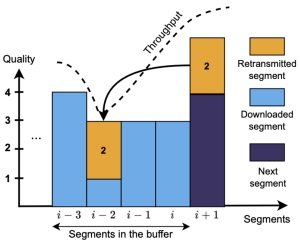
Abstract: As the video streaming traffic in mobile networks is increasing, improving the content delivery process becomes crucial, e.g., by utilizing edge computing support. At an edge node, we can deploy adaptive bitrate (ABR) algorithms with a better understanding of network behavior and access to radio and player metrics. In this work, we present ECAS-ML, Edge Assisted Adaptation Scheme for HTTP Adaptive Streaming with Machine Learning. ECAS-ML focuses on managing the tradeoff among bitrate, segment switches and stalls to achieve a higher quality of experience (QoE). For that purpose, we use machine learning techniques to analyze radio throughput traces and predict the best parameters of our algorithm to achieve better performance. The results show that ECAS-ML outperforms other client-based and edge-based ABR algorithms.

Keywords: HTTP Adaptive Streaming, Edge Computing, Content
Delivery, Network-assisted Video Streaming, Quality of Experience,
Machine Learning.

Posted in ATHENA | Comments Off on ECAS-ML: Edge Computing Assisted Adaptation Scheme with Machine Learning for HTTP Adaptive Streaming