Bitrate Ladder Analysis for UHD Adaptive Streaming: From AVC to AV2
IEEE International Conference on Visual Communications and Image Processing (VCIP 2026)
December 13 – December 16, 2026
Singapore
[PDF]
Kamran Qureshi (AAU, Austria), Hadi Amirpour (AAU, Austria), Christian Timmerer (AAU, Austria)
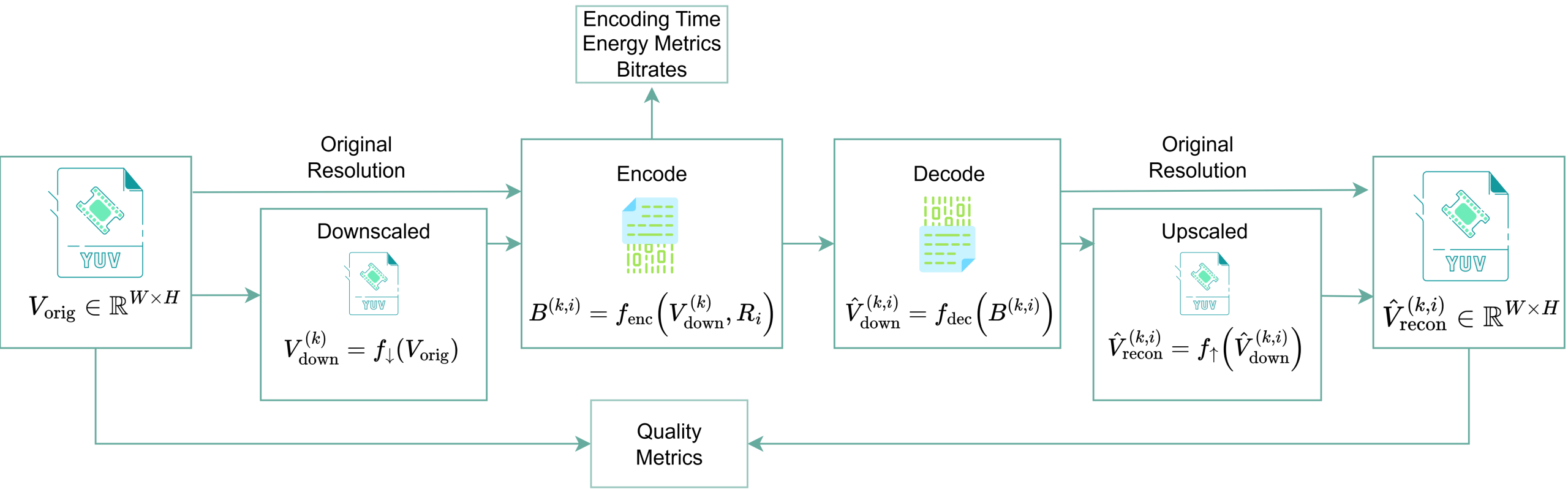
Abstract: Advances in video coding continue to improve compression efficiency for adaptive bitrate (ABR) streaming. However, improved coding efficiency also changes the rate-distortion characteristics of encoded video, thereby altering the resolution transition points and the resulting bitrate ladder for UHD adaptive streaming. A convex-hull-based evaluation was performed to compare codec-dependent bitrate ladders across H.264/AVC, H.265/HEVC, H.266/VVC, AV1, and AV2 using six UHD sequences from the JVET Common Test Conditions. Experimental results showed that higher codec efficiency systematically shifts resolution transition points toward lower bitrates. Relative to AV1, AV2 reduced the median 2160p-1080p transition bitrate by approximately 3x, while the median 1080p-720p and 720p-540p transition bitrates were approximately 9x lower, allowing higher spatial resolutions to remain optimal over a wider bitrate range. Complexity analysis of the evaluated AVC, HEVC, VVC, and AV1 encoders further showed that improved compression efficiency is accompanied by increased encoding time and energy consumption. These findings demonstrate that advances in video compression influence adaptive streaming by modifying the optimal bitrate ladder rather than simply reducing bitrate requirements.