MoQSplat: Adaptive Progressive Streaming of 3D Gaussian Splatting over MoQ
IEEE International Workshop on Multimedia Signal Processing (MMSP)
September 22 – September 24, 2026
Istanbul, Turkey
[PDF]
Emanuele Artioli (AAU, Austria), Mohammadreza Ghafari (Universit´e de Lorraine, France), Md Tariqul Islam (UNICAMP, Brazi), Farzad Tashtarian (AAU, Austria), Christian Rothenberg (UNICAMP, Brazi), Christian Timmerer (AAU, Austria)
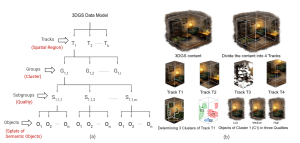
Abstract. 3D Gaussian Splatting (3DGS) delivers photorealistic novel view synthesis by representing scenes as millions of explicit Gaussian primitives. However, transmitting this data efficiently over a network remains a challenge for immersive applications. Realistic scenes can easily exceed several gigabytes, and traditional HTTP Adaptive Streaming over TCP introduces Head-of-Line (HOL) blocking that is ill-suited to the fine-grained, spatially selective delivery of 3DGS content. We propose MoQSplat to map 3DGS content onto the Media over QUIC (MoQ) transport hierarchy. MoQSplat partitions the scene into spatial Tracks, organizes splats into semantically coherent Groups via object-aware spatial clustering, and constructs progressive-quality Subgroups, each mapped to an independent QUIC stream to eliminate spatial HOL blocking. Crucially, MoQSplat features a completely stateless, subscriber-driven adaptation loop. The client selectively requests spatial regions and quality tiers based on live frustum visibility, distance, and foveal centrality. We validate the architecture’s core components by comparing opacity-based and scale-based pruning strategies for Subgroup generation.