Thin-Client Interactive Gaussian Adaptive Streaming over HTTP/3
ACM Multimedia 2026
November 10 – November 14, 2026
Rio de Janeiro, Brazil
[PDF]
Emanuele Artioli (AAU, Austria), Philipp Fößl (AAU, Austria), Shao-Yang Hung (National Tsinghua University, Taiwan), Daniele Lorenzi (Bitmovin, Austria), Farzad Tashtarian (AAU, Austria), Mahdi Dolati (Sharif University of Technology, Iran), Cheng-Hsin Hsu (National Tsinghua University, Taiwan), Christian Timmerer (AAU, Austria)
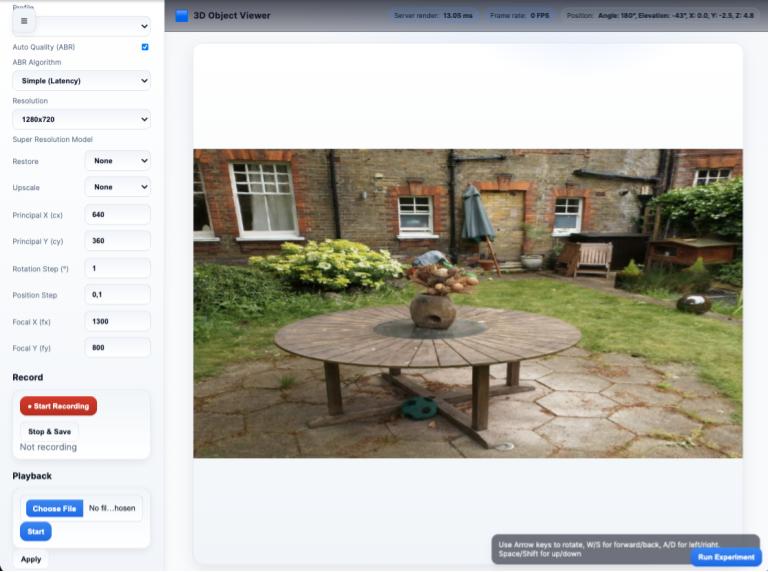
Abstract: Recent advancements in 3D Gaussian Splatting (3DGS) have enabled photorealistic rendering of complex scenes, yet widespread adoption on mobile and Extended Reality (XR) devices is hindered by substantial computational and bandwidth requirements. While existing solutions often focus on model compression for client-side rendering, they still demand significant GPU power, limiting applicability on resource-constrained hardware. We propose TIGAS (Thin-client Interactive Gaussian Adaptive Streaming), a remote rendering framework offloading rasterization to a backend. To bypass the prohibitive latencies connected to fluctuating network conditions, TIGAS streams view-dependent 2D projections to a lightweight web client over QUIC, minimizing head-of-line (HoL) blocking. A dedicated ABR algorithm adapts rendering quality to fluctuating network conditions, maintaining motion-to-photon latency within strict 6DoF interactive constraints. Furthermore, we discuss the integration of an experimental WebGPU super-resolution pipeline to analyze the trade-offs between perceptual quality enhancements and thin-client processing bottlenecks. We extensively evaluate TIGAS across multi-continental environments using 14 3DGS models and real 6DoF EyeNavGS movement traces. Powered by a backend rendering frames in under 10 milliseconds, TIGAS maintains latency within interactive thresholds while achieving an average SSIM of 0.88, serving both as a robust testbed for 3DGS streaming research and a capable delivery system.